
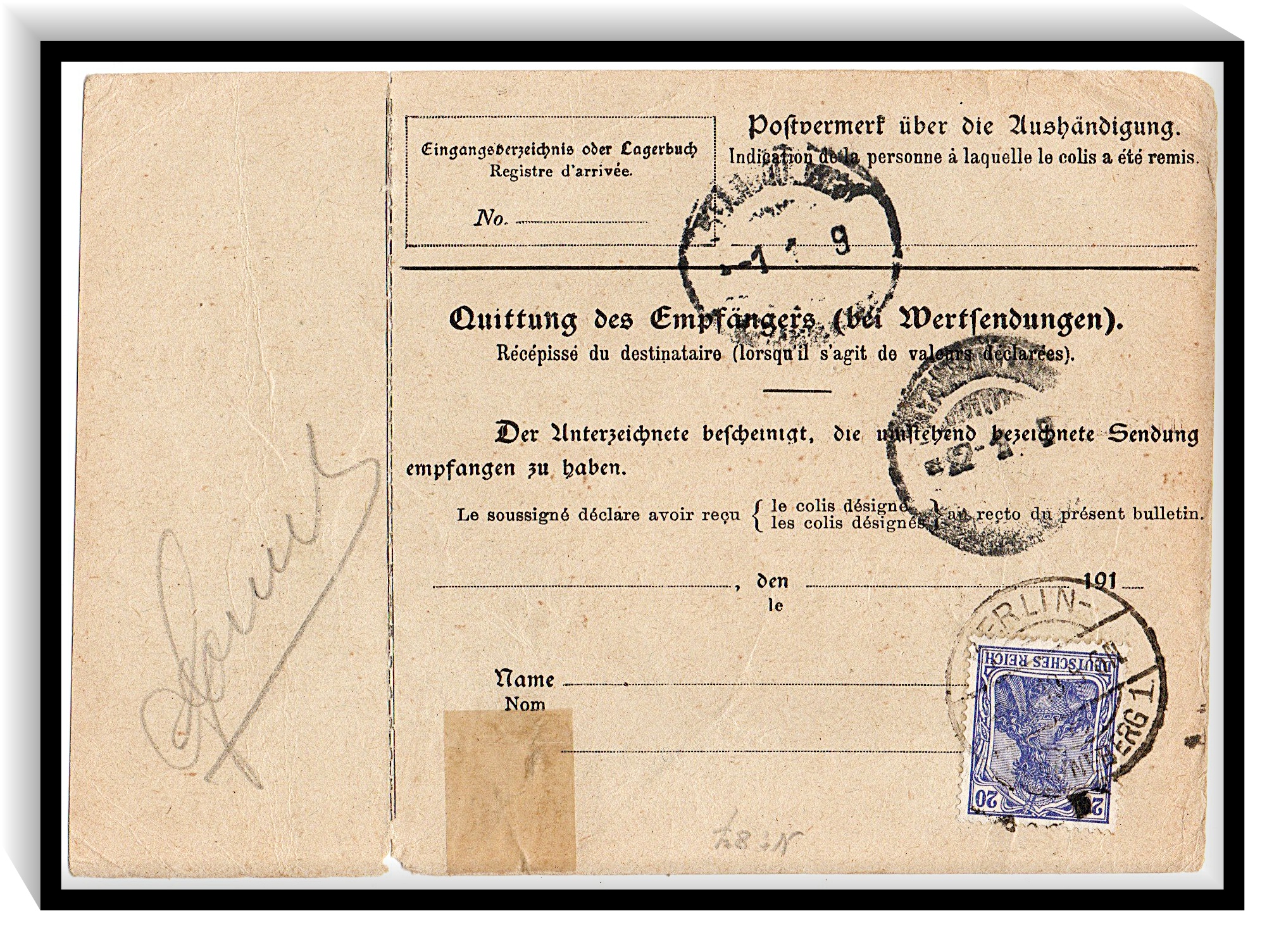
Date of use : 1918, Germany
KARTOPHOT Package Card Sent from Berlin to Constantinople
This document represents an important postal and logistical form illustrating commercial connections between Europe and the Ottoman Empire in the early twentieth century. Its structured layout and multilingual content indicate that it is not a simple envelope but an official accompanying document used for international parcel shipments. The use of both German and French reflects the standardized communication practices of the international postal system of the period.
The sender, Kartophot G.m.b.H., was a Berlin-Schöneberg-based company operating in the field of photographic materials. Available evidence suggests that the firm specialized in the trade of photographic paper. This indicates that Kartophot functioned primarily as a distributor and supplier rather than a manufacturer. Berlin's role as a major center for photographic and printing technologies at the time facilitated the expansion of such firms into international markets.
The recipient is addressed through the Ottoman Imperial Post Office in Constantinople, with the name "Mrs. Dollinger & Dielmann" likely referring to a local commercial agent, distributor, or business dealing with photographic supplies. This reflects direct commercial links between European suppliers and local actors within the Ottoman market.
The marking "Via Oesterreich" indicates that the shipment was routed through Austria, one of the principal transit corridors connecting Central Europe to the Ottoman Empire. The development of railway infrastructure enabled faster and more reliable transportation along this route. The document therefore provides insight not only into postal procedures but also into the logistics of international trade.
From a philatelic perspective, the presence of German Empire stamps and Berlin postal cancellations confirms that the item was processed through the official postal system. The reverse side includes a delivery confirmation section, demonstrating that the shipment was subject to control and verification procedures typical of commercial consignments with declared value.
From a collecting perspective, this document holds significant value across multiple themes. It serves as a primary source for the distribution and trade of photographic materials, while also illustrating the interaction between European and Ottoman postal systems. The circulation of photographic paper as a key material highlights the global organization of photographic practice.
Record Information
Title: KARTOPHOT Package Card Sent from Berlin to Constantinople
Category: Photographic Industry History / Postal Logistics
Subcategory: International Trade / Parcel Post
Country: German Empire (Origin) → Ottoman Empire (Destination)
🗺️ Show Route
City: Berlin-Schöneberg → Constantinople (Istanbul) (via Austria)
Date of use: circa 1918
Company (Sender): Kartophot G.m.b.H., Berlin-Schöneberg - distributor of photographic paper and materials
Recipient: Mrs. Dollinger & Dielmann, Ottoman Imperial Post Office, Constantinople (commercial agent or distributor)
Product: Photographic paper (primary trade item)
Object Type: International parcel post accompanying document / package card
Postal Route 🚂: Berlin, Germany → Constantinople, Ottoman Empire (via Austria / "Via Oesterreich")
Estimated Travel Time: Approximately 5-7 days (by rail via Vienna, Budapest, Belgrade, Sofia)
Postal Features: German Empire stamps, Berlin postal cancellations, "Via Oesterreich" routing mark, multilingual form (German/French), delivery confirmation section on reverse
Language: German, French
Material: Paper parcel card
Dimensions: Standard parcel form format
Collection Theme: German-Ottoman trade, Kartophot company history, photographic paper distribution, WWI-era logistics, Austro-German transit routes, international postal cooperation
Archival Significance: This 1918 package card documents the export of photographic paper from Berlin to Constantinople, illustrating German-Ottoman commercial ties during WWI. Kartophot's role as a distributor reflects Berlin's position in the photographic supply chain. The "Via Oesterreich" routing and bilingual form highlight the logistics and standardized procedures of international parcel post. It is a primary source for understanding the material trade supporting photographic practice in the Ottoman Empire.
Research Note:
This article is based on historical research and independent analysis of the material in the author's collection. The text has been prepared as an original interpretative study and does not reproduce copyrighted material.
This item is documented as part of the Photography in Postal History research project.
For research context, see the Research Methodology.
For academic reference, please refer to How to Cite This Archive.
For research context, see the Research Methodology.
For academic reference, please refer to How to Cite This Archive.
No comments:
Post a Comment