Showing posts with label Germany. Show all posts

Thursday, 16 October 2025

Paul Reinicke Rudolstadt Photo Envelope

Date of use : 1907 Germany

Paul Reinicke Rudolstadt Photo Envelope

This envelope was prepared by the firm Paul Reinicke, which operated in the town of Rudolstadt, Germany. The ornate Art Nouveau-style camera engraving and decorative frame elements on the front of the envelope reflect a rich visual design and the aesthetic sensibilities of the period. Although we do not have detailed information about the company, the phrase "Versandhaus für photographische Artikel" clearly indicates that the envelope was used by the firm for the mail-order sale of photographic equipment.
Record Information
Title: Paul Reinicke Rudolstadt Photo Envelope
Category: Photographic Trade History / Commercial Ephemera
Subcategory: Mail-Order Business / Advertising Design
Country: Germany
City: Rudolstadt
Date: c. 1907
Company: Paul Reinicke, Versandhaus für photographische Artikel
Object Type: Commercial envelope / advertising stationery
Design Style: Art Nouveau / Jugendstil
Design Elements: Ornate camera engraving, decorative frame
Business Type: Mail-order photographic equipment supplier
Language: German
Material: Paper envelope with printed design
Dimensions: Standard early 20th century envelope format
Collection Theme: German mail-order photography, commercial Art Nouveau design, early 20th century advertising
Archival Significance: This envelope represents the intersection of photographic commerce and Art Nouveau design in early 20th-century Germany. The ornate camera engraving and decorative frame demonstrate how photographic businesses invested in visual branding to attract customers. The designation "Versandhaus für photographische Artikel" confirms that Paul Reinicke operated as a mail-order supplier, part of the growing trend of distance selling that made photographic equipment accessible beyond major urban centers. While detailed company records may not survive, this envelope preserves evidence of the commercial infrastructure that supported amateur and professional photography in provincial Germany. The item is a valuable artifact for understanding the marketing and distribution channels of the early photographic industry.
Research Note:
This article is based on historical research and independent analysis of the material in the author's collection. The text has been prepared as an original interpretative study and does not reproduce copyrighted material.
This item is documented as part of the Photography in Postal History research project.
For research context, see the Research Methodology.
For academic reference, please refer to How to Cite This Archive.

Wednesday, 2 July 2025

Contessa-Nettel Envelope with Hyperinflation Stamp

Date of use : 1923 Germany

Contessa-Nettel Envelope with Hyperinflation Stamp

The recipient of this envelope is the company Contessa-Nettel. The company was a German camera manufacturer established in 1919 in Stuttgart, Germany, through the merger of Contessa Camerawerke Drexler & Nagel and Nettel Camerawerk. Contessa-Nettel was particularly known for producing stereoscopic cameras and models equipped with focal-plane shutters. In 1926, it merged with ICA, Ernemann, and Goerz to become part of the Zeiss Ikon company. Headquartered at Dornhaldenstraße 5 in Stuttgart, Contessa-Nettel AG moved to this location in 1913 during the expansion of Contessa Camerawerke.
The company gained fame especially for its large-format cameras such as the Deckrullo-Nettel, which were highly popular among both professional photographers and advanced amateurs.
Additional information: This envelope bears a postage stamp with a face value of two million marks. The stamps were issued in 1923, during the peak of hyperinflation in Germany. At that time, the German currency had drastically devalued, and monetary amounts reached astronomical levels. Even basic daily necessities required millions of marks. Banks and businesses were compelled to use stamps with extremely high nominal values for commercial transactions. This envelope serves as a compelling example of the economic chaos and financial inflation of that era.
Record Information
Title: Contessa-Nettel Envelope with Hyperinflation Stamp
Category: Photographic Industry History / Postal History
Subcategory: German Camera Manufacturing / Weimar Republic Inflation
Country: Germany
City: → Stuttgart
Date of use: 1923 (hyperinflation period)
Company: Contessa-Nettel AG, Stuttgart (founded 1919, merged into Zeiss Ikon 1926)
Company History: Formed by merger of Contessa Camerawerke Drexler & Nagel and Nettel Camerawerk; headquartered at Dornhaldenstraße 5 (occupied since 1913)
Notable Products: Stereoscopic cameras, focal-plane shutter models, Deckrullo-Nettel large-format cameras
Object Type: Commercial postal cover / business correspondence
Postal Features: Stamp with face value of 2,000,000 marks (hyperinflation era)
Historical Context: Weimar Republic hyperinflation (1923), astronomical postal rates
Language: German
Material: Paper envelope
Dimensions: Standard commercial envelope format
Collection Theme: German camera industry, Zeiss Ikon predecessors, Weimar Republic economic history, hyperinflation postal rates
Archival Significance: This envelope documents the commercial correspondence of Contessa-Nettel AG, a significant German camera manufacturer that would become part of Zeiss Ikon in 1926. The company's products, including stereoscopic cameras and the Deckrullo-Nettel large-format models, represent important developments in early 20th-century German camera technology. Beyond its photographic significance, the envelope is a powerful artifact of the 1923 hyperinflation crisis in the Weimar Republic. The 2,000,000-mark stamp illustrates the dramatic currency devaluation that forced businesses to use stamps with astronomical face values for ordinary commercial mail. This dual significance—as both photographic industry history and economic history—makes the envelope a valuable primary source. It connects the specialized world of camera manufacturing to the broader economic turbulence that shaped Germany in the early 1920s, providing insight into how businesses operated during a period of extreme financial instability.
Research Note:
This article is based on historical research and independent analysis of the material in the author's collection. The text has been prepared as an original interpretative study and does not reproduce copyrighted material.
This item is documented as part of the Photography in Postal History research project.
For research context, see the Research Methodology.
For academic reference, please refer to How to Cite This Archive.

Sunday, 22 June 2025

Wartime Optics and Propaganda Postcard, 1940

Date of use : 1940, Germany

Wartime Optics and Propaganda Postcard, 1940

This postcard was sent in 1940 from Heidelberg, Germany, to the J. Weidinger Fotohaus company located in Linz, Austria. Although the sender's company name is not explicitly mentioned on the card, the content suggests that it was a firm dealing in binoculars or similar optical devices, and that it held bank accounts in several European countries. This indicates that the company operated on an international scale, with regular shipments at least within the Central European region.
While little is known about the recipient company, the term "Fotohaus" implies that it was either a photographic studio or a retailer of photographic equipment. Thus, the card reflects the commercial connections between the fields of optics and photography during that era.
The content of the card is not limited to commercial information; it also includes propaganda elements typical of the wartime period. At the bottom of the message, it is stated that cash on delivery (Nachnahme) incurs an additional fee, while advance payment (Vorkasse) allows for free shipping. It is also emphasized that international shipments were only possible with advance payment.
A special cancellation mark on the card reads:
"Die Front kämpft – die Heimat spart. Kriegshilfswerk für das Deutsche Rote Kreuz"
"The front fights – the homeland saves. War Relief Organization for the German Red Cross"
This slogan is a classic example of World War II propaganda. It underlines the idea that the war effort was not limited to the battlefield, but that the civilian population was also expected to contribute—through saving and supporting organizations like the German Red Cross.
When we look at the back side of the card, we see that the sender is Ferdinand Acker, an optical company based in Heidelberg, Germany. This card serves as a discounted microscope sales list published by the company. It features a wide range of microscope models, from simple student microscopes to advanced professional laboratory instruments, each listed with its specific features and prices.
At the top of the card, the following headline is prominently displayed:
"Sonderangebot! Mikroskope"
"Special Offer! Microscopes"
Just below the headline, an important note appears:
"Die Preise gelten nur für die ab Lager lieferbaren Instrumente, sonst freibleibend. Zwischenverkauf vorbehalten."
This to:
"Prices apply only to instruments available from stock; otherwise, they are non-binding. Subject to prior sale."
This statement emphasizes that the microscopes listed in the catalog are available in limited quantities and that the prices apply only while supplies last. It also clearly indicates that the company reserves the right to sell the products in the meantime and that the listed prices are not guaranteed.
Record Information
Title: Wartime Optics and Propaganda Postcard, 1940
Category: Optical Industry History / Wartime Correspondence
Subcategory: Commercial Propaganda / Instrument Sales
Country: Germany (Origin) → Austria (Destination) 🗺️ Show Route
City: Heidelberg → Linz
Date of use: 1940 (World War II period)
Sender: Ferdinand Acker, Heidelberg (optical instruments company)
Recipient: J. Weidinger Fotohaus, Linz/Donau, Schmiedestr. 2
Banking Network: Accounts in Germany, Czechoslovakia, Hungary, Netherlands, Denmark, Italy
Payment Terms: Cash on delivery (Nachnahme) adds fees; advance payment (Vorkasse) free shipping; international shipments only with advance payment
Postal Markings: Propaganda cancellation: "Die Front kämpft – die Heimat spart. Kriegshilfswerk für das Deutsche Rote Kreuz"
Object Type: Commercial postcard / price list / propaganda item
Product Featured: Microscopes (special offer)
Sales Terms: "Prices apply only to instruments available from stock; otherwise, non-binding. Subject to prior sale."
Language: German
Material: Printed card stock
Dimensions: Standard postcard format
Collection Theme: Wartime commerce, optical instrument trade, Nazi propaganda, cross-border business networks
Archival Significance: This 1940 postcard captures the intersection of commerce and Nazi propaganda. The recto features a German Red Cross propaganda cancellation, while the verso contains a microscope price list from Ferdinand Acker. The sender's extensive international banking network (Germany, Czechoslovakia, Hungary, Netherlands, Denmark, Italy) illustrates Central European commercial connections during wartime. Payment terms reflect wartime economic constraints. A primary source for understanding business operations under Nazi rule and the integration of propaganda into daily commerce.
Research Note:
This article is based on historical research and independent analysis of the material in the author's collection. The text has been prepared as an original interpretative study and does not reproduce copyrighted material.
This item is documented as part of the Photography in Postal History research project.
For research context, see the Research Methodology.
For academic reference, please refer to How to Cite This Archive.

Monday, 9 June 2025

ARGENTA: German Photo Paper Icon

Date of use : 1930, Germany

ARGENTA: German Photo Paper Icon

The phrase ARGENTA – Fabrik photographischer Papiere appears on the front side of this commercial postcard, clearly indicating that the company was engaged in the production of photographic paper. As the name suggests, ARGENTA specialized in manufacturing photographic papers with specially coated surfaces suitable for photochemical processes; these papers were used for both black-and-white and color photographic prints. The postcard also features a special cancellation stamp bearing the phrase "DER RUNDFUNK BRINGT UNTERHALTUNG, MEHRT DAS WISSEN!" (Broadcasting brings entertainment, increases knowledge!).
Here, the term "broadcasting" refers specifically to radio transmissions, which were among the most important mass communication tools of the era. In 1930s Germany, radio was extensively utilized for mass propaganda and educational purposes, and this slogan reflects a typical propaganda message embodying the spirit of the time.
Looking into the history of ARGENTA, the company was founded in 1918 in the Munich-Pasing district of Germany by Ludwig Müller under the name "ARGENTA – Fabrik photographischer Papiere." Ludwig Müller, though trained as a musician and known as a composer and zither player under the pseudonym "Waldmüller," chose to pursue a career in commerce and turned his focus to the photographic industry. The company quickly specialized in photographic paper production and became an important supplier within Germany. In 1938, the Pasing district was incorporated into Munich, thus bringing ARGENTA's headquarters within the city limits.
ARGENTA was particularly renowned for producing high-quality photographic papers for black-and-white photography. Its product range included baryta-coated heavyweight papers, which were suitable for specialized photographic techniques such as bromoil printing. Additionally, metallic papers in copper, silver, and gold tones were favored for artistic prints. Introduced in 1962, Photoleinen (photographic canvas) was designed for use in stage decorations, advertising prints, and graphic reproductions.
Unfortunately, during World War II, ARGENTA's factory in Munich was completely destroyed in air raids. Nevertheless, the company did not cease operations and was rebuilt after the war, continuing its production. However, ARGENTA ceased production in 1991 and was officially liquidated in 1992. Over its approximately 74 years of operation, ARGENTA established itself as a significant presence in the photographic industry, leaving a lasting legacy within the sector.
The following text appears on the back of the card:
✉️ LETTER CONTENT ✉️
Munich 42, August 30, 1930
I take the liberty of reminding you of the outstanding amount of RM 6.97, dated April 1, and kindly expect that the mentioned amount, along with RM 0.30 in additional charges, be transferred no later than September 9 of this year, so that I may close your account.
In the meantime, I present my respects and remain sincerely yours,
Argenta
Photographic Paper Factory
Ludwig Kühl
Record Information
Title: ARGENTA: German Photo Paper Icon
Category: Photographic Manufacturing History / Commercial Ephemera
Subcategory: Paper Manufacturing / German Industrial History
Country: Germany (Origin) → Austria (Destination) 🗺️ Show Route
City: Munich-Pasing → Linz
Date of use: 30 August 1930 (based on letter date)
Company: ARGENTA – Fabrik photographischer Papiere, founded 1918 by Ludwig Müller, Munich-Pasing (incorporated into Munich 1938), ceased production 1991, liquidated 1992
Founder: Ludwig Müller (also known as composer and zither player "Waldmüller")
Product Range: Baryta-coated heavyweight papers (for bromoil printing), metallic papers (copper, silver, gold tones), Photoleinen (photographic canvas, introduced 1962)
Recipient: Photohaus Weidinger, Linz a. Donau, Platz d.12.Nov.23
Object Type: Commercial postcard / business correspondence / payment reminder
Postal Features: Special cancellation: "DER RUNDFUNK BRINGT UNTERHALTUNG, MEHRT DAS WISSEN!"
Banking Details: Bayer. Staatsbank München, Postscheckkonto München Nr. 37600
Language: German
Material: Printed card stock with handwritten additions
Dimensions: Standard postcard format
Collection Theme: German photographic paper industry, Weimar Republic propaganda, interwar commerce, paper technology history
Archival Significance: This 1930 ARGENTA postcard documents a significant German photographic paper manufacturer founded in 1918 by Ludwig Müller, a musician-turned-industrialist. The company's specialized products—baryta-coated papers for bromoil printing and metallic-toned papers—represent the sophisticated demands of early 20th-century photography. The radio propaganda cancellation reflects Weimar Republic social messaging. ARGENTA's 74-year history, including WWII destruction and post-war rebuilding, encapsulates the trajectory of specialized German photographic manufacturers. A primary source for understanding photographic paper technology and interwar German commerce.
Research Note:
This article is based on historical research and independent analysis of the material in the author's collection. The text has been prepared as an original interpretative study and does not reproduce copyrighted material.
This item is documented as part of the Photography in Postal History research project.
For research context, see the Research Methodology.
For academic reference, please refer to How to Cite This Archive.

Tuesday, 3 June 2025

Photo-Gaudernack: Letter from Dresden to a Baron

Date of use : 1948 Germany

Photo-Gaudernack: Letter from Dresden to a Baron

This cover from the year 1948 was sent by a photography studio named "Photo-Gaudernack" located in Dresden, Germany. The company's address is listed as Walderseeplatz 12, in the Dresden-A.16 district, while another address—Stresemannplatz 12—is also visible but crossed out. This suggests that the company may have undergone a change of address during that period. The name "Photo-Gaudernack" indicates that the firm operated in the field of photography, likely offering services such as portrait photography, printing, or other studio-related work. The recipient of the envelope is a man addressed with the noble title "Freiherr" (Baron), named Leo von Ungern-Sternberg.
Record Information
Title: Photo-Gaudernack: Letter from Dresden to a Baron
Category: Photographic Studio History / Postal History
Subcategory: Post-WWII Correspondence / German Social History
Country: Germany
City: Dresden
Date of use: 1948 (post-WWII period)
Studio: Photo-Gaudernack, Dresden-A.16, Walderseeplatz 12 (also Stresemannplatz 12 address crossed out)
Recipient: Freiherr (Baron) Leo von Ungern-Sternberg
Object Type: Commercial postal cover / studio correspondence
Postal Administration: German postal service (post-WWII occupation period)
Language: German
Material: Paper envelope
Dimensions: Standard envelope format
Collection Theme: German photography studios, post-WWII Dresden, noble titles in 20th century, address changes in occupied Germany
Archival Significance: This 1948 cover from Photo-Gaudernack in Dresden documents the operations of a photography studio in the challenging post-World War II period. The crossed-out address (Stresemannplatz 12) and new address (Walderseeplatz 12) may reflect the extensive destruction Dresden suffered during the war and the subsequent reorganization of the city. The recipient, Freiherr Leo von Ungern-Sternberg, represents the continued use of noble titles in German correspondence even after the formal abolition of aristocratic privileges. This item illustrates how photographic studios maintained commercial relationships in the immediate post-war years and provides insight into the social networks connecting photographers with clients of various backgrounds. The envelope is a primary source for understanding the resilience of small businesses in war-torn Germany and the persistence of traditional social structures alongside the new realities of the occupation period.
Research Note:
This article is based on historical research and independent analysis of the material in the author's collection. The text has been prepared as an original interpretative study and does not reproduce copyrighted material.
This item is documented as part of the Photography in Postal History research project.
For research context, see the Research Methodology.
For academic reference, please refer to How to Cite This Archive.

Monday, 5 August 2024

Benö Fischer: Sofia-Based Photo Supplier with Global Reach

Date of use : Bulgaria (circa WWI)

Benö Fischer: Sofia-Based Photo Supplier with Global Reach

This envelope represents a commercial correspondence sent from Sofia, Bulgaria, to Berlin, Germany, directly related to the photographic trade. The sender, identified as "Benö Fischer – Sofia," indicates a business specialized in photographic materials. The multilingual structure of the printed heading reflects an international orientation, suggesting connections with both local and Central European trade networks.
Within an archival and industrial context, Benö Fischer appears to have operated as a supplier of photographic equipment in Sofia during the early 20th century. The company likely dealt in cameras, photographic chemicals, and related accessories, serving both wholesale and retail markets. Although detailed biographical information about the founder is limited, the name suggests a Central European origin, possibly linked to German or Austro-Hungarian commercial circles.
The recipient, J. Schüssler, is identified as a civil engineer based in Berlin-Friedenau. This indicates that the correspondence may have involved not only commercial exchange but also technical communication related to photographic or optical applications.
From a postal history perspective, the postmark on the envelope is only partially legible. While the day and month can be identified, the year is not clearly readable due to overlapping impressions and wear. As a result, it is not possible to determine an exact date. However, when the type of stamp, the graphic style of the envelope, and the presence of a censorship label on the reverse are considered together, it is reasonable to suggest that the document likely dates to the period of the First World War. This conclusion is not based on a directly readable date but on contextual and philatelic evaluation.
The censorship label and official marking on the reverse confirm that the item was inspected during transit. Such practices were particularly common during wartime, when international correspondence was subject to control and monitoring.
From a visual standpoint, the envelope features a highly decorative commercial design. The ornate framing and inclusion of photographic imagery reinforce the company's identity and demonstrate how such envelopes functioned as both communication tools and advertising media.
🛡️ REVERSE SIDE - CENSORSHIP MARKING WWI Era
📌 Observation:
The reverse side of this envelope bears a censorship label and an official marking, confirming that the correspondence was inspected during transit.
Such practices were standard procedure during the First World War (1914-1918), when international mail was subject to rigorous control and monitoring by military authorities.
The presence of this censorship marking, combined with the partially illegible postmark and the decorative graphic style of the envelope, supports the contextual dating of this item to the WWI period.
🛡️ Censorship labels are valuable philatelic evidence of wartime postal controls and international communication restrictions.
Record Information
Title: Benö Fischer: Sofia-Based Photo Supplier with Global Reach
Category: Photographic Industry History / Wartime Commerce
Subcategory: International Trade / Censored Mail
Country: Bulgaria (Sender: Sofia) → Germany (Recipient: Berlin) 🗺️ Show Route
City: Sofia → Berlin-Friedenau
Date of use: Inferred as World War I era (circa 1914-1918). Postmark year illegible; dated contextually by stamp type, graphic style, and censorship label.
Company (Sender): Benö Fischer, Sofia, Bulgaria. Supplier of photographic equipment, cameras, chemicals, and accessories. Name suggests Central European origin, operating in wholesale/retail markets.
Recipient: J. Schüssler, Civil Engineer (Königl. Baurat), Berlin-Friedenau. Indicates possible technical or commercial correspondence.
Object Type: Decorative commercial envelope / advertising cover
Postal Route 🚂🛡️ (Estimated Route): Sofia, Bulgaria → Berlin, Germany (WWI Era)
Estimated Travel Time: Approximately 5-10 days (wartime delays, censorship inspection)
Postal Features: Partially legible postmark, censorship label and official marking on reverse (indicating wartime inspection), multilingual printed heading
Distinctive Feature: Highly ornate design with photographic imagery, functioning as both correspondence and advertising medium
Language: Multiple (Bulgarian, German inferred)
Material: Paper envelope
Dimensions: Standard envelope format
Collection Theme: Benö Fischer company history, Balkan-European photographic trade, WWI-era censorship, commercial graphic design, advertising ephemera, technical correspondence.
Archival Significance: This envelope from Benö Fischer in Sofia to Berlin documents photographic trade between the Balkans and Central Europe during WWI. The decorative design illustrates commercial correspondence doubling as advertising. The censorship label confirms wartime postal controls. This item is a primary source for understanding regional supply chains and communication under wartime conditions.
Research Note:
This article is based on historical research and independent analysis of the material in the author's collection. The text has been prepared as an original interpretative study and does not reproduce copyrighted material.
This item is documented as part of the Photography in Postal History research project.
For research context, see the Research Methodology.
For academic reference, please refer to How to Cite This Archive.

Friday, 2 August 2024

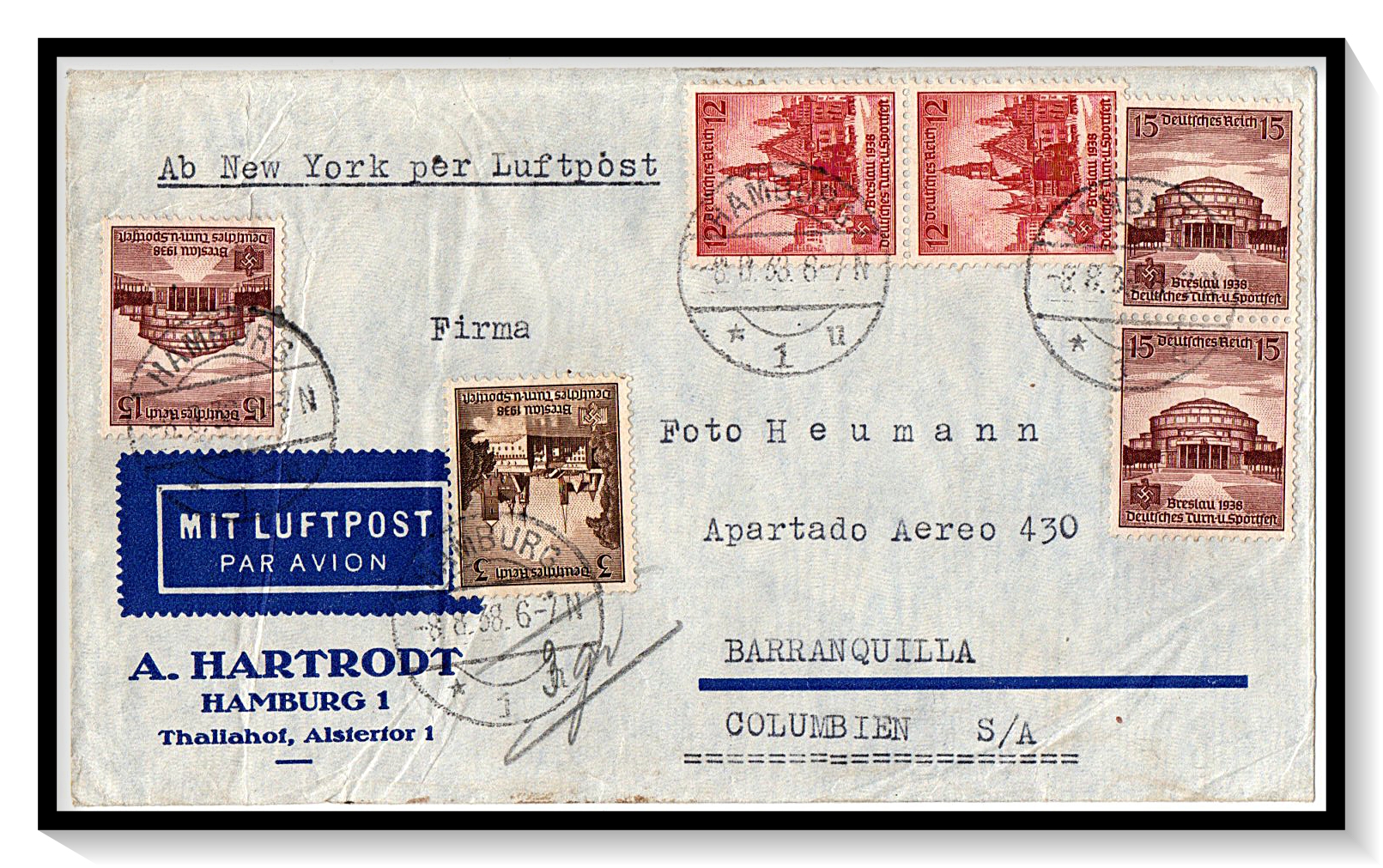
Foto Heumann: German-Colombian Photography Studio in 1938

Date of use : 1938, Germany

Foto Heumann: German-Colombian Photography Studio in 1938

This envelope represents a significant postal document reflecting the commercial and technical communication networks established between Europe and South America during the early 20th century. The sender, A. Hartrodt, was a Hamburg-based logistics and transportation company. Founded in the late 19th century, the firm operated primarily in maritime transport and international freight organization. Given Hamburg's central role in global trade networks, such companies played a crucial role in facilitating the movement of goods and information between Europe and the American continents.
The recipient, identified as "Foto Heumann," was located in Barranquilla, Colombia. As a major Caribbean port city, Barranquilla emerged in the first half of the 20th century as one of the country's key commercial and distribution centers. The firm was most likely founded and operated by a photographer of German origin, Erwin Heumann. Its activities extended beyond conventional studio work, focusing particularly on urban landscapes and the visual documentation of the city. This suggests that the enterprise combined commercial photography with a documentary-oriented approach, contributing to the visual construction of urban identity.
The inscription "Ab New York per Luftpost" indicates that the item was routed via New York and transported by airmail. This detail highlights the multi-stage nature of transatlantic postal routes during the period. Mail originating in Europe was often directed first to North America before being forwarded to South America, reflecting the structure of early global airmail networks. Such routes were commonly used by businesses requiring faster communication.
The presence of the "Mit Luftpost / Par Avion" label clearly designates the item as airmail. German postage stamps and cancellations confirm that the envelope was processed through the official postal system under regulated tariffs. The arrival postmark from Barranquilla, dated August 1938, indicates successful delivery. Additional control markings suggest that the envelope underwent standard inspection procedures.
Within its broader economic context, this document demonstrates that the photographic and optical industries were not confined to local markets but were integrated into global trade networks. Photographic equipment and materials produced in Europe were exported to developing markets such as Latin America, creating multi-layered commercial connections between logistics firms, producers, and regional distributors.
Record Information
Title: Foto Heumann: German-Colombian Photography Studio in 1938
Category: Photographic Industry History / International Trade
Subcategory: Transatlantic Airmail / Studio Documentation
Country: Germany (Origin) → Colombia (Destination) (via USA) 🗺️ Show Route
City: Hamburg → Barranquilla (routed through New York)
Date of use: 1938 (arrival in Barranquilla: August 1938)
Company (Sender): A. Hartrodt, Hamburg - logistics and transportation company, founded late 19th century, specializing in maritime transport and international freight.
Company (Recipient): Foto Heumann, Barranquilla, Colombia. Studio founded by Erwin Heumann (German origin). Specialized in commercial photography and urban landscape documentation.
Object Type: International airmail cover ("Mit Luftpost / Par Avion")
Postal Route ✈️🚢: Hamburg, Germany → New York, USA → Barranquilla, Colombia (1938 Transatlantic Route)
Estimated Travel Time: Approximately 7-10 days (Hamburg → New York: 3-5 days by air/sea, New York → Barranquilla: 2-4 days by air)
Postal Features: "Mit Luftpost / Par Avion" label, "Ab New York per Luftpost" routing instruction, German stamps and cancellations, Barranquilla arrival postmark (August 1938), control/inspection markings
Language: German, Spanish
Material: Paper envelope
Dimensions: Standard envelope format
Collection Theme: German-Latin American photographic trade, Erwin Heumann studio history, Barranquilla commercial photography, transatlantic airmail development, 1930s logistics networks, urban visual documentation
Archival Significance: This 1938 airmail cover documents the connection between German logistics firm A. Hartrodt and the Barranquilla-based studio Foto Heumann, founded by German photographer Erwin Heumann. The routing "Ab New York per Luftpost" and arrival postmark provide precise evidence of early airmail infrastructure. This item is a primary source for understanding how European photographic expertise and commerce reached South American markets in the 1930s.
Research Note:
This article is based on historical research and independent analysis of the material in the author's collection. The text has been prepared as an original interpretative study and does not reproduce copyrighted material.
This item is documented as part of the Photography in Postal History research project.
For research context, see the Research Methodology.
For academic reference, please refer to How to Cite This Archive.

Monday, 29 July 2024

Leopold Stump Pharmacy: Photography & Trade in Frankfurt

Date of use : 1948 Germany

Leopold Stump Pharmacy: Photography & Trade in Frankfurt

This document is a commercial envelope representing official correspondence from a business operating in Frankfurt am Main, Germany. The inscription "Leopold Stump – Löwen-Drogerie Photo-Handlung" indicates that the company was engaged in both chemical goods and photographic materials. The address on Leipziger Straße situates the firm within an important commercial district of Frankfurt. The term "Drogerie" in the company name indicates that the business was not limited to photographic materials but was also involved in the trade of chemical products. Such enterprises were often rooted in pharmacy-related traditions, and due to the chemically based nature of photography, they naturally expanded into the photographic sector.
Although detailed founding information about the company remains limited, the combined use of "Drogerie" and "Photo-Handlung" suggests a business model that included the sale of photographic chemicals, films, papers, and related consumables. These hybrid enterprises became increasingly common during the early 20th century due to the chemical foundations of photographic production.
The recipient is identified as the "Industrie- und Handelskammer," or Chamber of Industry and Commerce. In a major commercial center such as Frankfurt, this institution played a key role in regulating and supporting business activities. The document therefore reflects communication between a commercial enterprise and an official economic body.
Postal markings and the stamp indicate that the envelope was processed within the German postal system. Its simple layout reflects standard practices in commercial and institutional correspondence of the period.
In conclusion, this document illustrates the relationship between a business engaged in photographic and chemical trade and institutional economic structures, offering insight into the broader integration of the photographic industry within commercial systems.
Record Information
Title: Leopold Stump Pharmacy: Photography & Trade in Frankfurt
Category: Photographic Industry History / Commercial Correspondence
Subcategory: Business-Institution Relations / Hybrid Retail
Country: Germany
City: Frankfurt am Main (Leipziger Straße address)
Date of use: 1948
Company (Sender): Leopold Stump, Löwen-Drogerie Photo-Handlung, Frankfurt. A hybrid business combining a pharmacy/drugstore ("Drogerie") with a photographic materials shop ("Photo-Handlung"), selling chemicals, films, papers, and related consumables.
Recipient: Industrie- und Handelskammer (Chamber of Industry and Commerce), Frankfurt. Official economic regulatory and support body.
Object Type: Domestic commercial envelope (business correspondence)
Postal Features: German postal stamp, standard cancellation, simple layout typical of commercial/institutional correspondence
Language: German
Material: Paper envelope
Dimensions: Standard envelope format
Collection Theme: Hybrid photographic-chemical retail, Frankfurt commercial history, post-war business administration, pharmacy-photography connection, Chamber of Industry and Commerce correspondence.
Archival Significance: This 1948 envelope from Leopold Stump's Löwen-Drogerie Photo-Handlung to the Frankfurt Chamber of Industry and Commerce illustrates the integration of photography into existing retail structures. The hybrid "Drogerie" and "Photo-Handlung" model reflects the chemical foundations of photography, which allowed pharmacies to expand into photographic supply. This document is a primary source for understanding how photographic materials reached consumers through diversified local businesses and how those businesses interacted with official economic institutions in post-war Germany.
Research Note:
This article is based on historical research and independent analysis of the material in the author's collection. The text has been prepared as an original interpretative study and does not reproduce copyrighted material.
This item is documented as part of the Photography in Postal History research project.
For research context, see the Research Methodology.
For academic reference, please refer to How to Cite This Archive.