Showing posts with label OttomanEmpire. Show all posts

Monday, 1 July 2024

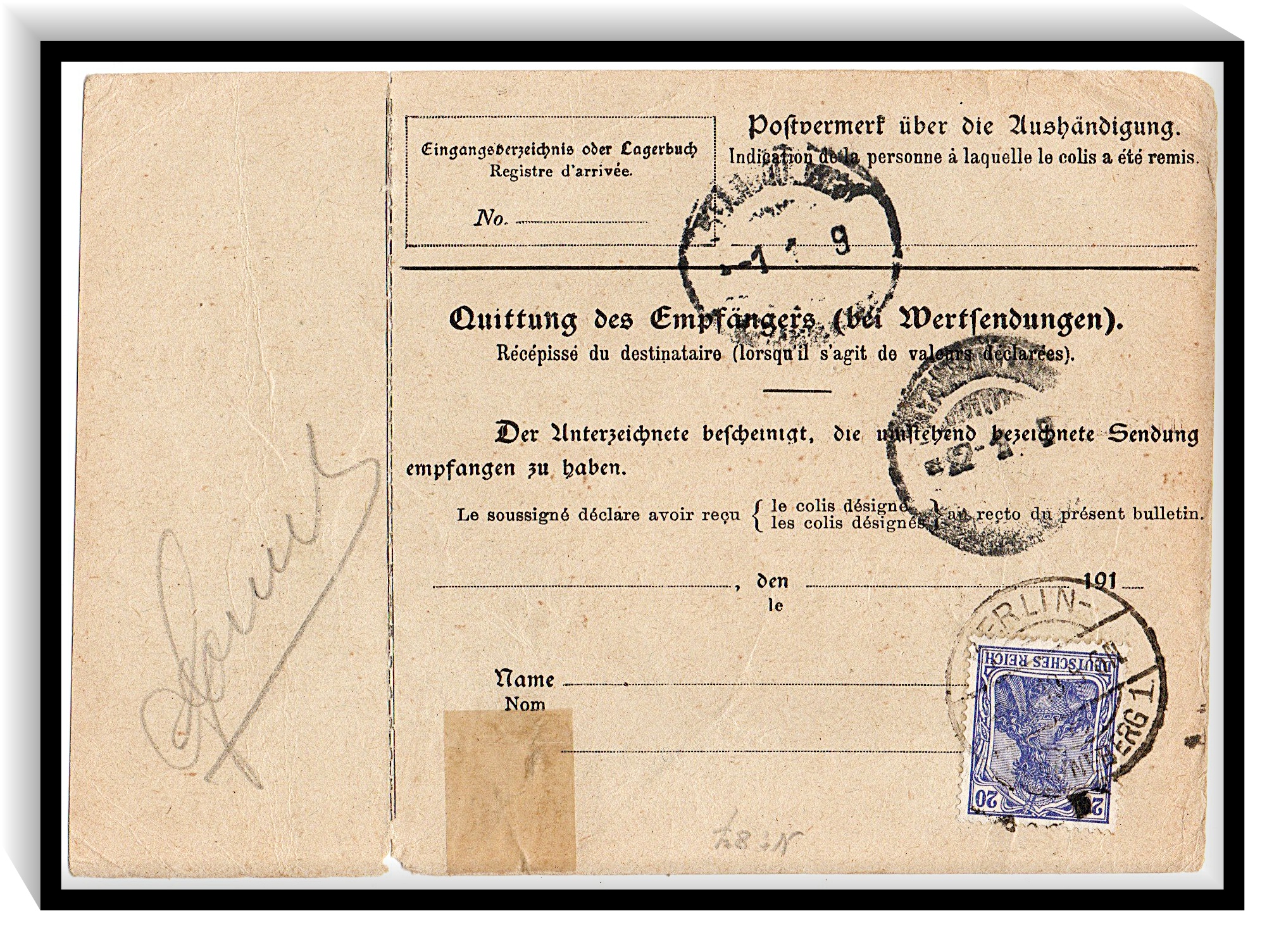
KARTOPHOT Package Card Sent from Berlin to Constantinople

Date of use : 1918, Germany

KARTOPHOT Package Card Sent from Berlin to Constantinople

This document represents an important postal and logistical form illustrating commercial connections between Europe and the Ottoman Empire in the early twentieth century. Its structured layout and multilingual content indicate that it is not a simple envelope but an official accompanying document used for international parcel shipments. The use of both German and French reflects the standardized communication practices of the international postal system of the period.
The sender, Kartophot G.m.b.H., was a Berlin-Schöneberg-based company operating in the field of photographic materials. Available evidence suggests that the firm specialized in the trade of photographic paper. This indicates that Kartophot functioned primarily as a distributor and supplier rather than a manufacturer. Berlin's role as a major center for photographic and printing technologies at the time facilitated the expansion of such firms into international markets.
The recipient is addressed through the Ottoman Imperial Post Office in Constantinople, with the name "Mrs. Dollinger & Dielmann" likely referring to a local commercial agent, distributor, or business dealing with photographic supplies. This reflects direct commercial links between European suppliers and local actors within the Ottoman market.
The marking "Via Oesterreich" indicates that the shipment was routed through Austria, one of the principal transit corridors connecting Central Europe to the Ottoman Empire. The development of railway infrastructure enabled faster and more reliable transportation along this route. The document therefore provides insight not only into postal procedures but also into the logistics of international trade.
From a philatelic perspective, the presence of German Empire stamps and Berlin postal cancellations confirms that the item was processed through the official postal system. The reverse side includes a delivery confirmation section, demonstrating that the shipment was subject to control and verification procedures typical of commercial consignments with declared value.
From a collecting perspective, this document holds significant value across multiple themes. It serves as a primary source for the distribution and trade of photographic materials, while also illustrating the interaction between European and Ottoman postal systems. The circulation of photographic paper as a key material highlights the global organization of photographic practice.
Record Information
Title: KARTOPHOT Package Card Sent from Berlin to Constantinople
Category: Photographic Industry History / Postal Logistics
Subcategory: International Trade / Parcel Post
Country: German Empire (Origin) → Ottoman Empire (Destination) 🗺️ Show Route
City: Berlin-Schöneberg → Constantinople (Istanbul) (via Austria)
Date of use: circa 1918
Company (Sender): Kartophot G.m.b.H., Berlin-Schöneberg - distributor of photographic paper and materials
Recipient: Mrs. Dollinger & Dielmann, Ottoman Imperial Post Office, Constantinople (commercial agent or distributor)
Product: Photographic paper (primary trade item)
Object Type: International parcel post accompanying document / package card
Postal Route 🚂: Berlin, Germany → Constantinople, Ottoman Empire (via Austria / "Via Oesterreich")
Estimated Travel Time: Approximately 5-7 days (by rail via Vienna, Budapest, Belgrade, Sofia)
Postal Features: German Empire stamps, Berlin postal cancellations, "Via Oesterreich" routing mark, multilingual form (German/French), delivery confirmation section on reverse
Language: German, French
Material: Paper parcel card
Dimensions: Standard parcel form format
Collection Theme: German-Ottoman trade, Kartophot company history, photographic paper distribution, WWI-era logistics, Austro-German transit routes, international postal cooperation
Archival Significance: This 1918 package card documents the export of photographic paper from Berlin to Constantinople, illustrating German-Ottoman commercial ties during WWI. Kartophot's role as a distributor reflects Berlin's position in the photographic supply chain. The "Via Oesterreich" routing and bilingual form highlight the logistics and standardized procedures of international parcel post. It is a primary source for understanding the material trade supporting photographic practice in the Ottoman Empire.
Research Note:
This article is based on historical research and independent analysis of the material in the author's collection. The text has been prepared as an original interpretative study and does not reproduce copyrighted material.
This item is documented as part of the Photography in Postal History research project.
For research context, see the Research Methodology.
For academic reference, please refer to How to Cite This Archive.

Saturday, 5 February 2022

Photographische Gesellschaft Letter, Ottoman Empire

Date of use : 1915, Ottoman Empire

Photographische Gesellschaft Letter, Ottoman Empire

During the early twentieth century the photographic industry expanded rapidly within a European-centered technological and commercial system. The production of cameras, optical equipment, photographic paper, and printing technologies became concentrated particularly in Germany, Austria, and France. At the same time economic relations between the Ottoman Empire and Central Europe were intensifying. Photographic equipment, chemical materials, and printing technologies formed an important component of this international exchange. The postal cover examined here represents a documentary example of these connections between the Ottoman Empire and the German photographic industry.
The recipient clearly identified on the envelope is Neue Photographische Gesellschaft Aktiengesellschaft, a German photographic company established in 1890 in the district of Steglitz near Berlin. Within a relatively short time the company developed into one of the most important photographic printing and image reproduction institutions in Europe. The emergence of the firm coincided with the rapid industrialization of photographic technologies in Germany, and the company became one of the major participants in this development. Its activities focused primarily on photomechanical printing processes, the photographic reproduction of artworks, and large-scale postcard production.
Neue Photographische Gesellschaft functioned not merely as a photographic studio but as an industrial image production enterprise. Its production facilities in Berlin-Steglitz employed techniques such as photogravure and bromide printing to produce images in large quantities. The company reproduced artworks, portraits, and photographic subjects and distributed them through European publishing networks and the expanding postcard market. Through these activities the firm contributed significantly to the development of modern visual culture. The address printed on the envelope, Siemensstrasse 27, corresponds to the location of the company's administrative and production facilities in Steglitz.
During the early twentieth century the Steglitz district of Berlin developed into an important industrial and technological environment. The area hosted numerous printing companies, optical workshops, and photographic production facilities. Germany's leading position in the photographic industry was supported by a broad industrial infrastructure that included camera manufacturing, photographic paper production, chemical industries, and photomechanical printing enterprises.
The letter was sent from the Ottoman Empire and bears a one-piastre Ottoman postage stamp. The stamp design includes architectural imagery representing historic mosques of Istanbul, a motif frequently used in Ottoman postal iconography to symbolize imperial identity. The cancellation mark contains the French form of the city's name, "Constantinople." French served as the principal administrative language of international postal communication during the nineteenth and early twentieth centuries, and its presence on Ottoman postal markings reflects this broader diplomatic convention.
A red rectangular handstamp written in Ottoman Turkish appears on the envelope and represents a postal censorship marking. Such markings indicate that the correspondence passed through official inspection. Censorship of international mail was commonly implemented during periods of war or heightened political tension. Within the Ottoman Empire the monitoring of foreign correspondence became particularly common during the years surrounding the First World War. The presence of this censorship mark therefore suggests that the letter most likely circulated during a period when international mail traffic was subject to official examination.
During the same period the photographic profession within the Ottoman Empire was expanding steadily. Istanbul, particularly the districts of Beyoğlu and Galata, had become a center of photographic studios and commercial photography. Ottoman photographers and studio operators relied heavily on imported equipment such as cameras, glass plates, photographic papers, and chemical materials manufactured in European industrial centers. Germany was among the principal suppliers of these materials, which led to the establishment of commercial relationships between Ottoman photographic professionals and German manufacturers. In this context a letter addressed to the Neue Photographische Gesellschaft in Berlin likely concerned commercial matters such as photographic materials, catalogues, or business correspondence. Although the exact content of the letter is unknown, such an interpretation is plausible given the trade patterns of the period.
From a philatelic perspective the envelope represents a document that intersects several collecting fields. The Ottoman postage stamp and Constantinople cancellation situate the item within Ottoman postal history. At the same time the international destination and the commercial nature of the correspondence connect the object to broader themes of trade and communication history. Because the recipient is a major photographic printing company, the cover also holds significance for collections focused on the history of photography and the photographic industry.
In conclusion, this postal cover should be understood as more than a simple piece of mail. It represents a small yet meaningful trace of the international networks that shaped the photographic industry in the early twentieth century. The document illustrates the connections linking the Ottoman postal system with the industrial photographic centers of Germany. As such it provides valuable evidence of the technological and commercial circulation that underpinned the development of modern visual culture.
Record Information
Title: Photographische Gesellschaft Letter, Ottoman Empire
Category: Photographic Industry History / International Trade
Subcategory: International Correspondence / Wartime Censorship
Country: Ottoman Empire (Sender: Constantinople) → Germany (Recipient: Berlin) 🗺️ Show Route
City: Constantinople (Istanbul) (Sender) → Berlin (Recipient: Neue Photographische Gesellschaft AG)
Date of use: 1915
Company (Recipient): Neue Photographische Gesellschaft Aktiengesellschaft, Siemensstrasse 27, Steglitz, Berlin, Germany. A major German photographic printing and image reproduction company founded in 1890, specializing in photomechanical printing processes, art reproductions, and large-scale postcard production.
Object Type: International commercial envelope with printed address
Postal Route 🚂🚢: Constantinople (Istanbul) → Berlin (via Balkan railway and Central Europe) (Estimated Route)
Estimated Travel Time: Approximately 5-7 days (railway via Balkan route)
Postal Features: Ottoman 1-piastre stamp with Istanbul mosque architectural imagery; Constantinople postal cancellation; red rectangular Ottoman Turkish censorship handstamp.
Language: French (recipient address), Ottoman Turkish (censorship marking)
Material: Paper envelope
Dimensions: Standard envelope format
Notable Feature: Ottoman postal censorship marking from the First World War period; correspondence between the Ottoman Empire and a major German photographic company; Constantinople postal cancellation with French place name.
Collection Theme: Neue Photographische Gesellschaft, NPG, Berlin photographic industry, Ottoman photography, Constantinople, Istanbul, First World War censorship, Ottoman postal history, German-Ottoman trade, photomechanical printing, postcard production.
Archival Significance: This 1915 envelope documents commercial correspondence between the Ottoman Empire and a major German photographic company, featuring wartime postal censorship, illustrating the international trade networks and communication systems during the First World War.
Research Note:
This article is based on historical research and independent analysis of the material in the author's collection. The text has been prepared as an original interpretative study and does not reproduce copyrighted material.
This item is documented as part of the Photography in Postal History research project.
For research context, see the Research Methodology.
For academic reference, please refer to How to Cite This Archive.