Showing posts with label PhotographicPaper. Show all posts

Monday, 1 July 2024

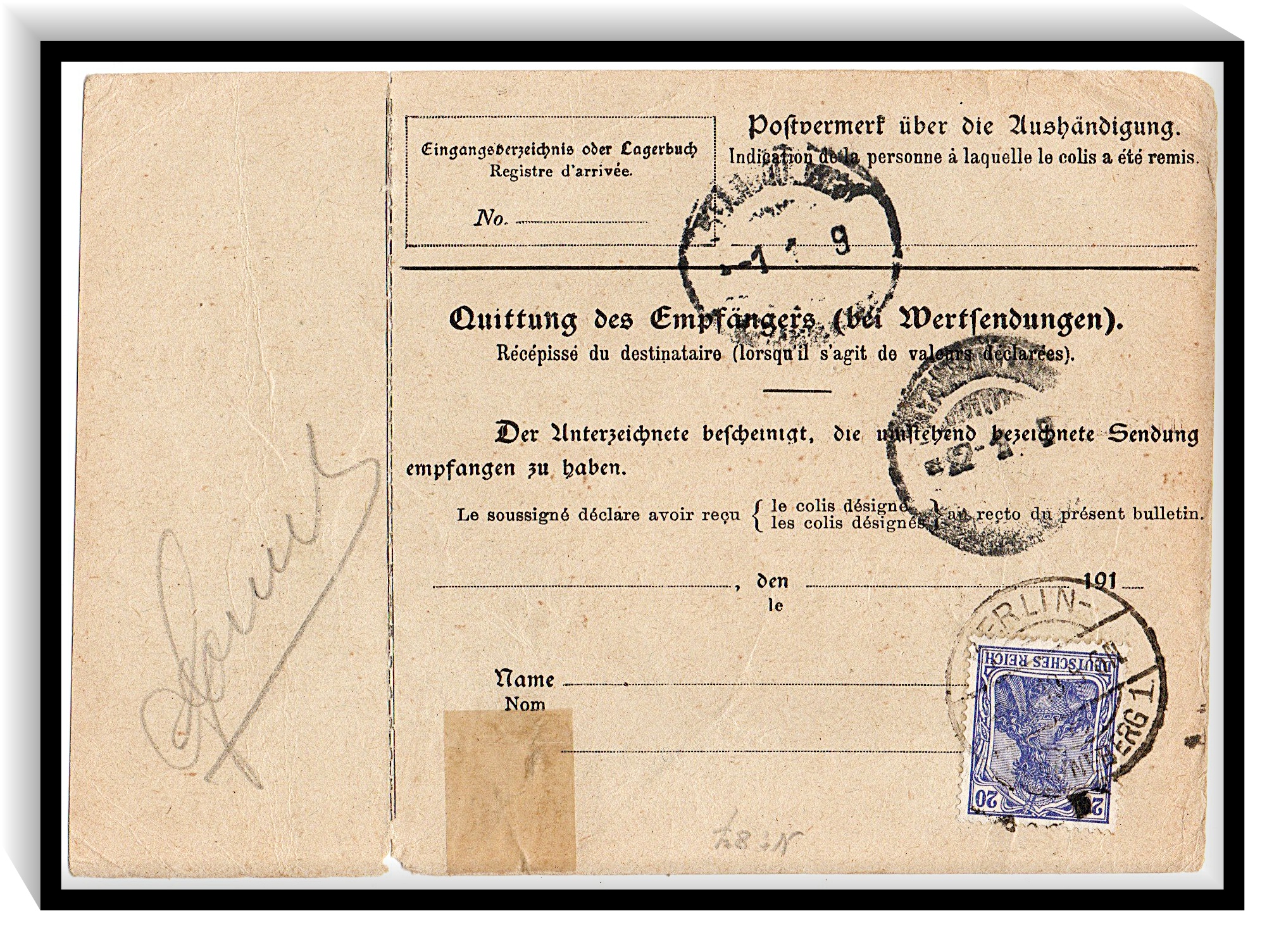
KARTOPHOT Package Card Sent from Berlin to Constantinople

Date of use : 1918, Germany

KARTOPHOT Package Card Sent from Berlin to Constantinople

This document represents an important postal and logistical form illustrating commercial connections between Europe and the Ottoman Empire in the early twentieth century. Its structured layout and multilingual content indicate that it is not a simple envelope but an official accompanying document used for international parcel shipments. The use of both German and French reflects the standardized communication practices of the international postal system of the period.
The sender, Kartophot G.m.b.H., was a Berlin-Schöneberg-based company operating in the field of photographic materials. Available evidence suggests that the firm specialized in the trade of photographic paper. This indicates that Kartophot functioned primarily as a distributor and supplier rather than a manufacturer. Berlin's role as a major center for photographic and printing technologies at the time facilitated the expansion of such firms into international markets.
The recipient is addressed through the Ottoman Imperial Post Office in Constantinople, with the name "Mrs. Dollinger & Dielmann" likely referring to a local commercial agent, distributor, or business dealing with photographic supplies. This reflects direct commercial links between European suppliers and local actors within the Ottoman market.
The marking "Via Oesterreich" indicates that the shipment was routed through Austria, one of the principal transit corridors connecting Central Europe to the Ottoman Empire. The development of railway infrastructure enabled faster and more reliable transportation along this route. The document therefore provides insight not only into postal procedures but also into the logistics of international trade.
From a philatelic perspective, the presence of German Empire stamps and Berlin postal cancellations confirms that the item was processed through the official postal system. The reverse side includes a delivery confirmation section, demonstrating that the shipment was subject to control and verification procedures typical of commercial consignments with declared value.
From a collecting perspective, this document holds significant value across multiple themes. It serves as a primary source for the distribution and trade of photographic materials, while also illustrating the interaction between European and Ottoman postal systems. The circulation of photographic paper as a key material highlights the global organization of photographic practice.
Record Information
Title: KARTOPHOT Package Card Sent from Berlin to Constantinople
Category: Photographic Industry History / Postal Logistics
Subcategory: International Trade / Parcel Post
Country: German Empire (Origin) → Ottoman Empire (Destination) 🗺️ Show Route
City: Berlin-Schöneberg → Constantinople (Istanbul) (via Austria)
Date of use: circa 1918
Company (Sender): Kartophot G.m.b.H., Berlin-Schöneberg - distributor of photographic paper and materials
Recipient: Mrs. Dollinger & Dielmann, Ottoman Imperial Post Office, Constantinople (commercial agent or distributor)
Product: Photographic paper (primary trade item)
Object Type: International parcel post accompanying document / package card
Postal Route 🚂: Berlin, Germany → Constantinople, Ottoman Empire (via Austria / "Via Oesterreich")
Estimated Travel Time: Approximately 5-7 days (by rail via Vienna, Budapest, Belgrade, Sofia)
Postal Features: German Empire stamps, Berlin postal cancellations, "Via Oesterreich" routing mark, multilingual form (German/French), delivery confirmation section on reverse
Language: German, French
Material: Paper parcel card
Dimensions: Standard parcel form format
Collection Theme: German-Ottoman trade, Kartophot company history, photographic paper distribution, WWI-era logistics, Austro-German transit routes, international postal cooperation
Archival Significance: This 1918 package card documents the export of photographic paper from Berlin to Constantinople, illustrating German-Ottoman commercial ties during WWI. Kartophot's role as a distributor reflects Berlin's position in the photographic supply chain. The "Via Oesterreich" routing and bilingual form highlight the logistics and standardized procedures of international parcel post. It is a primary source for understanding the material trade supporting photographic practice in the Ottoman Empire.
Research Note:
This article is based on historical research and independent analysis of the material in the author's collection. The text has been prepared as an original interpretative study and does not reproduce copyrighted material.
This item is documented as part of the Photography in Postal History research project.
For research context, see the Research Methodology.
For academic reference, please refer to How to Cite This Archive.

Thursday, 30 June 2022

Mimosa Photographic Paper and Film Advertising Meter

Date of use : 1930, Germany

Mimosa Photographic Paper and Film Advertising Meter

This commercial envelope processed in Dresden is associated with Mimosa A.G., a German company involved in the production and distribution of photographic materials. The red machine cancellation visible at the top of the envelope indicates that the item was handled within the Dresden postal system. Integrated into the cancellation is a promotional inscription reading "Mimosa Photo-papiere, Films, Platten." This phrase refers to photographic papers, films, and glass plates, clearly identifying the company's activity within the photographic materials industry. The date within the cancellation suggests that the envelope was mailed in early December 1930.
Mimosa A.G. operated in Dresden, a city widely recognized as one of the important centers of photographic and optical manufacturing in Germany. The presence of numerous camera manufacturers, optical workshops, and chemical producers created a dense industrial environment closely connected to photographic technology. Within this context, companies specializing in photographic paper and light-sensitive materials played a crucial role in supporting photographic production. Mimosa belonged to this group of firms supplying essential materials required for photographic printing and image development.
The origins of the company can be traced to the early decades of the twentieth century, when the demand for photographic printing materials expanded rapidly. Photographic paper constituted one of the fundamental components of photographic practice, as it allowed images captured on negatives to be transformed into visible prints. As photography gained popularity among both professional and amateur users, the production of photographic papers and related materials became an increasingly significant branch of the photographic industry.
Record Information
Title: Mimosa A.G. Advertising Meter Envelope (Dresden)
Category: Photographic Materials Industry / Postal Advertising
Subcategory: German Photographic Paper Manufacturers / Machine Cancellation Advertising
Country: Germany (Sender: Dresden) → Germany (Recipient)
City: Dresden (Sender: Mimosa A.G.) → [Domestic Recipient]
Date of use: December 1930
Company (Sender): Mimosa A.G., Dresden, Germany. A manufacturer and distributor of photographic materials, specializing in photographic papers, films, and glass plates.
Object Type: Commercial envelope (with machine cancellation advertising)
Postal Features: German "Deutsches Reich" postage stamp; Dresden machine cancellation with integrated promotional inscription "Mimosa Photo-papiere, Films, Platten"; red ink cancellation.
Language: German
Material: Paper envelope
Dimensions: Standard commercial envelope format
Collection Theme: Mimosa A.G., Dresden photographic industry, German photographic paper manufacturers, machine cancellations, postal advertising, Deutsches Reich postal system, photographic materials marketing, 1930s German postal history, light-sensitive materials.
Archival Significance: This 1930 envelope features a machine cancellation with an integrated advertising inscription for Mimosa A.G., a Dresden photographic materials manufacturer, illustrating the use of postal cancellations as a promotional medium within the German photographic industry during the early 1930s.
Research Note:
This article is based on historical research and independent analysis of the material in the author's collection. The text has been prepared as an original interpretative study and does not reproduce copyrighted material.
This item is documented as part of the Photography in Postal History research project.
For research context, see the Research Methodology.
For academic reference, please refer to How to Cite This Archive.

Saturday, 21 August 2021

Argenta Photographic Paper Business Stationery – Germany

Date of use : 1923, Germany

Argenta Photographic Paper Business Stationery – Germany

This envelope represents a commercial postal document connected to the photographic industry in early twentieth-century Germany. The printed heading in the upper left corner reads "Münchener Photowerk Gebrüder Müller – Fabrik photographischer Papiere – München 42," clearly identifying the sender as a Munich-based manufacturer of photographic printing paper. The German phrase "Fabrik photographischer Papiere" indicates that the company specialized in the production of light-sensitive photographic papers used by professional photographers and photographic studios.
A prominent graphic label on the envelope displays the brand names "Argenta" and "Alba." This label most likely served as a commercial trademark or advertising element used by the company to promote specific photographic paper products. During the late nineteenth and early twentieth centuries photographic paper manufacturers frequently marketed their products under distinct brand names that referred to particular paper types, surface qualities, or photographic processes. Such visual trademarks were commonly integrated into company stationery in order to reinforce brand recognition within professional photographic networks.
The envelope is addressed to "Fa. Fr. Grittmatter – Fotografie – Basel – Schweiz," indicating that the recipient was a photographer or photographic business located in Basel, Switzerland. Basel was an important commercial and cultural center in Switzerland during the early twentieth century and maintained strong economic connections with southern Germany. Trade between Germany and Switzerland in photographic materials was particularly active, as German manufacturers supplied a wide range of photographic products to professional photographers throughout Europe.
The postage stamps affixed to the envelope bear the inscription "Deutsches Reich" and display denominations expressed in billions of marks. These extremely high nominal values are characteristic of the hyperinflation period in Germany during 1923. As the value of the German currency rapidly declined, postal rates increased dramatically, forcing the German postal administration to issue stamps with very high denominations. The presence of stamps marked with values such as "2 Milliarden" indicates that the envelope was mailed during this extraordinary period of economic instability within the Weimar Republic.
Postal markings confirm that the envelope traveled through the official German postal system as part of an international commercial correspondence between Germany and Switzerland. Such documents provide valuable insight into the economic relationships that connected photographic manufacturers with professional photographers and distributors across Europe. Photographic paper manufacturers relied on extensive networks of professional clients, and business communication was frequently conducted through postal correspondence.
The document also reflects the broader industrial structure of the photographic sector during the early twentieth century. As photography became increasingly widespread, the demand for photographic paper grew significantly, leading to the development of specialized manufacturing firms. Germany was one of the leading centers of photographic production in Europe, with cities such as Munich, Berlin, and Dresden hosting numerous companies involved in photographic technology and materials.
From a collecting perspective, the envelope falls into several relevant categories. It can be classified as commercial correspondence related to the photographic industry. At the same time, the hyperinflation-era stamps place it within the philatelic history of the Weimar Republic. Finally, it serves as a documentary artifact illustrating the commercial relationships between photographic manufacturers and professional photographers in early twentieth-century Europe.
Record Information
Title: Argenta Photographic Paper Business Stationery – Germany
Category: Photographic Industry History / Manufacturing
Subcategory: International Trade / Weimar Republic Hyperinflation
Country: Germany (Sender: Munich) → Switzerland (Recipient: Basel) 🗺️ Show Route
City: Munich (Sender: Münchener Photowerk Gebrüder Müller) → Basel (Recipient: Fa. Fr. Grittmatter)
Date of use: 1923
Company (Sender): Münchener Photowerk Gebrüder Müller, München 42, Germany. A Munich-based manufacturer of photographic printing paper, producing products under the "Argenta" and "Alba" brand names.
Company (Recipient): Fa. Fr. Grittmatter, Fotografie, Basel, Switzerland. A photographer or photographic business in Basel.
Object Type: International commercial envelope with printed letterhead and brand label
Postal Route 🚂📮 (Estimated Route): Munich, Germany → Basel, Switzerland (c.1923)
Estimated Travel Time: Approximately 1-2 days (railway via Ulm, Stuttgart, Karlsruhe)
Postal Features: German postage stamps with "Deutsches Reich" inscription and billion-mark denominations (characteristic of 1923 hyperinflation); Munich postal cancellations.
Language: German
Material: Paper envelope
Dimensions: Standard envelope format
Notable Feature: Stamps with billion-mark denominations reflecting the German hyperinflation of 1923; printed brand label for "Argenta" and "Alba" photographic papers.
Collection Theme: Münchener Photowerk, Gebrüder Müller, Argenta, Alba, photographic paper manufacturing, Munich photographic industry, Basel photography, Weimar Republic, German hyperinflation, Deutsches Reich stamps, international photographic trade, professional photography supplies.
Archival Significance: This 1923 envelope documents the international trade of German photographic paper manufacturers during the Weimar Republic, while the billion-mark stamps provide tangible evidence of the hyperinflation crisis that affected postal communication.
Research Note:
This article is based on historical research and independent analysis of the material in the author's collection. The text has been prepared as an original interpretative study and does not reproduce copyrighted material.
This item is documented as part of the Photography in Postal History research project.
For research context, see the Research Methodology.
For academic reference, please refer to How to Cite This Archive.