Showing posts with label GermanPhotographers. Show all posts

Friday, 2 August 2024

Foto Heumann: German-Colombian Photography Studio in 1938

Date of use : 1938, Germany

Foto Heumann: German-Colombian Photography Studio in 1938

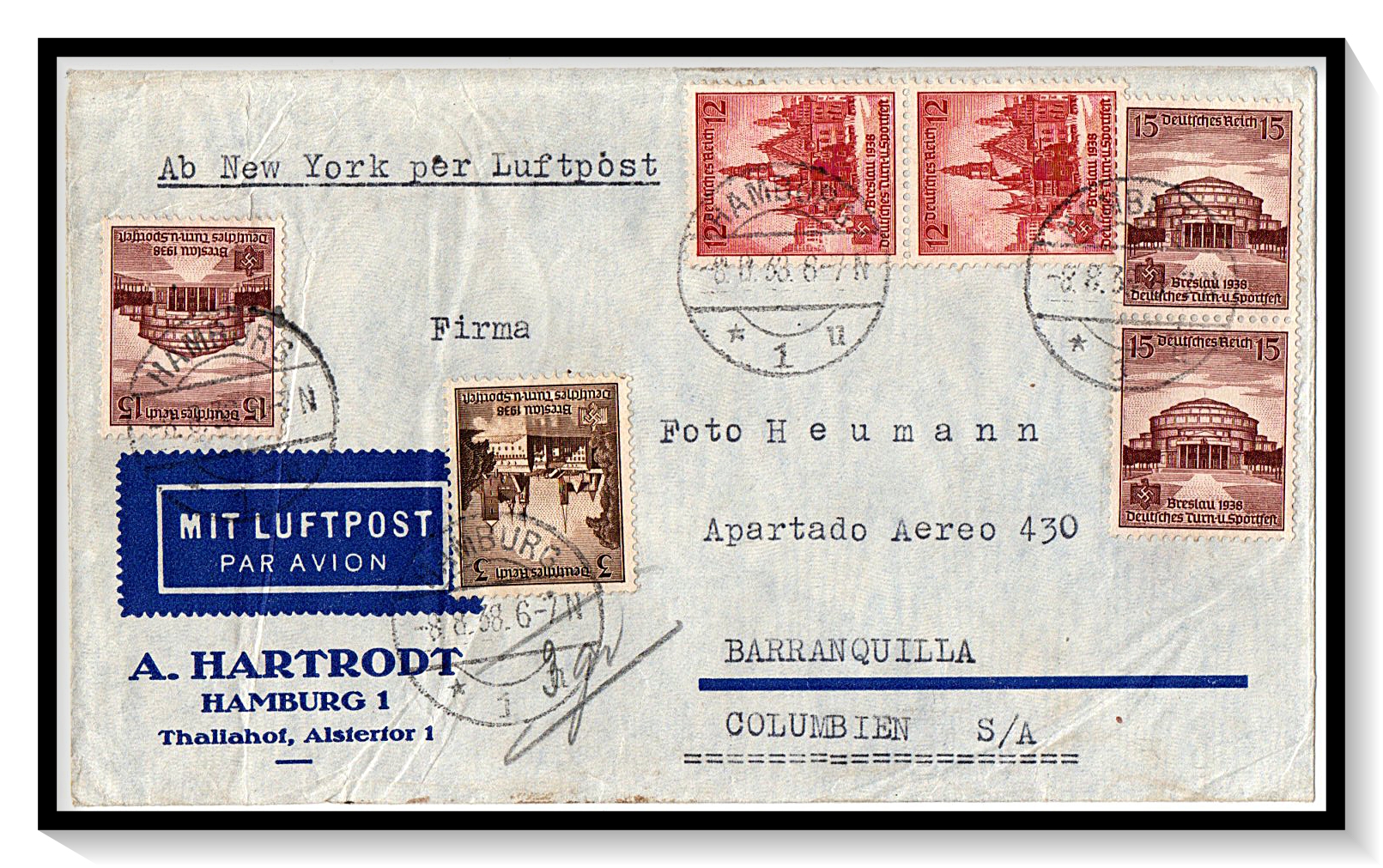
This envelope represents a significant postal document reflecting the commercial and technical communication networks established between Europe and South America during the early 20th century. The sender, A. Hartrodt, was a Hamburg-based logistics and transportation company. Founded in the late 19th century, the firm operated primarily in maritime transport and international freight organization. Given Hamburg's central role in global trade networks, such companies played a crucial role in facilitating the movement of goods and information between Europe and the American continents.
The recipient, identified as "Foto Heumann," was located in Barranquilla, Colombia. As a major Caribbean port city, Barranquilla emerged in the first half of the 20th century as one of the country's key commercial and distribution centers. The firm was most likely founded and operated by a photographer of German origin, Erwin Heumann. Its activities extended beyond conventional studio work, focusing particularly on urban landscapes and the visual documentation of the city. This suggests that the enterprise combined commercial photography with a documentary-oriented approach, contributing to the visual construction of urban identity.
The inscription "Ab New York per Luftpost" indicates that the item was routed via New York and transported by airmail. This detail highlights the multi-stage nature of transatlantic postal routes during the period. Mail originating in Europe was often directed first to North America before being forwarded to South America, reflecting the structure of early global airmail networks. Such routes were commonly used by businesses requiring faster communication.
The presence of the "Mit Luftpost / Par Avion" label clearly designates the item as airmail. German postage stamps and cancellations confirm that the envelope was processed through the official postal system under regulated tariffs. The arrival postmark from Barranquilla, dated August 1938, indicates successful delivery. Additional control markings suggest that the envelope underwent standard inspection procedures.
Within its broader economic context, this document demonstrates that the photographic and optical industries were not confined to local markets but were integrated into global trade networks. Photographic equipment and materials produced in Europe were exported to developing markets such as Latin America, creating multi-layered commercial connections between logistics firms, producers, and regional distributors.
Record Information
Title: Foto Heumann: German-Colombian Photography Studio in 1938
Category: Photographic Industry History / International Trade
Subcategory: Transatlantic Airmail / Studio Documentation
Country: Germany (Origin) → Colombia (Destination) (via USA) 🗺️ Show Route
City: Hamburg → Barranquilla (routed through New York)
Date of use: 1938 (arrival in Barranquilla: August 1938)
Company (Sender): A. Hartrodt, Hamburg - logistics and transportation company, founded late 19th century, specializing in maritime transport and international freight.
Company (Recipient): Foto Heumann, Barranquilla, Colombia. Studio founded by Erwin Heumann (German origin). Specialized in commercial photography and urban landscape documentation.
Object Type: International airmail cover ("Mit Luftpost / Par Avion")
Postal Route ✈️🚢: Hamburg, Germany → New York, USA → Barranquilla, Colombia (1938 Transatlantic Route)
Estimated Travel Time: Approximately 7-10 days (Hamburg → New York: 3-5 days by air/sea, New York → Barranquilla: 2-4 days by air)
Postal Features: "Mit Luftpost / Par Avion" label, "Ab New York per Luftpost" routing instruction, German stamps and cancellations, Barranquilla arrival postmark (August 1938), control/inspection markings
Language: German, Spanish
Material: Paper envelope
Dimensions: Standard envelope format
Collection Theme: German-Latin American photographic trade, Erwin Heumann studio history, Barranquilla commercial photography, transatlantic airmail development, 1930s logistics networks, urban visual documentation
Archival Significance: This 1938 airmail cover documents the connection between German logistics firm A. Hartrodt and the Barranquilla-based studio Foto Heumann, founded by German photographer Erwin Heumann. The routing "Ab New York per Luftpost" and arrival postmark provide precise evidence of early airmail infrastructure. This item is a primary source for understanding how European photographic expertise and commerce reached South American markets in the 1930s.
Research Note:
This article is based on historical research and independent analysis of the material in the author's collection. The text has been prepared as an original interpretative study and does not reproduce copyrighted material.
This item is documented as part of the Photography in Postal History research project.
For research context, see the Research Methodology.
For academic reference, please refer to How to Cite This Archive.

Tuesday, 26 July 2022

Arthur Benda and Studio d'Ora Legacy

Date of use : 1928, Austria

Arthur Benda and Studio d'Ora Legacy

This postcard documents a professional exchange between a photographic studio in Vienna and a newspaper editorial office in Prague. The typed text on the reverse indicates that the message was written in Vienna on 29 March 1928. The sender is identified by a stamp reading "d'Ora – Arthur Benda," which connects the correspondence to the renowned Viennese photographic studio Studio d'Ora. The studio was founded by Dora Kallmus (1881–1963), a pioneering photographer who gained international recognition as one of the first prominent female professionals in the field of portrait photography. Established in Vienna in 1907, the studio quickly achieved prestige among aristocratic circles, artists, and members of the cultural elite.
The name Arthur Benda (1883–1969) appearing on the card refers to a key collaborator within the studio. Benda worked closely with Dora Kallmus and became an important figure in the creative and commercial operations of the atelier. After the First World War the reputation of Studio d'Ora expanded significantly, and the studio developed extensive professional connections throughout Europe, including Paris and other cultural centers. Arthur Benda was particularly known for his portrait photography and contributed to many images associated with the distinctive style of the studio.
The postcard is addressed to the editorial department of "Das Leben" at the newspaper Prager Tagblatt. This newspaper, published in Prague in the German language, occupied an influential position within the intellectual and cultural environment of Central Europe. It regularly featured coverage of artistic and cultural topics and reached a broad readership. For photographic studios of the period, newspapers represented important channels through which portraits and visual material could circulate publicly.
The message itself confirms the return of photographs previously sent to the editorial office and notes that the editors retained image number 3316, titled "Hübel." This indicates that the studio had provided photographic material to the newspaper for potential publication. Images distributed in this way were often used to illustrate cultural articles, portraits of notable personalities, or features related to the arts. The postcard therefore reflects not only a courteous acknowledgment but also the practical workings of cooperation between photographic studios and the press.
Postal elements on the card include Austrian stamps and cancellation marks, indicating that the item was processed within the Austrian postal network and dispatched from Vienna. The layout follows the standard design used for official postcards in Central Europe during the interwar period. Such postcards offered a convenient and economical means of transmitting brief professional messages.
From a collecting perspective, this document holds significance in several areas. It is directly connected with Studio d'Ora, an institution of considerable importance in the history of portrait photography. At the same time, it provides insight into the relationship between photography and the press during the interwar years. Finally, it represents a piece of postal history illustrating communication between Austria and Czechoslovakia.
Record Information
Title: Studio d'Ora / Arthur Banda Business Postcard (Vienna to Prague)
Category: Photographic Studios / Press Relations
Subcategory: Austrian Portrait Photography / Cultural Journalism
Country: Austria (Sender: Vienna) → Czechoslovakia (Recipient: Prague)
City: Vienna (Sender: Studio d'Ora / Arthur Benda) → Prague (Recipient: Prager Tagblatt / Das Leben)
Date of use: 29 March 1928
Studio (Sender): Studio d'Ora (Dora Kallmus) and Arthur Benda, Vienna, Austria. A renowned Viennese portrait photography studio founded in 1907 by Dora Kallmus, one of the first prominent female professional photographers. Arthur Benda (1883–1969) was a key collaborator and photographer associated with the studio.
Object Type: Commercial postcard (business correspondence with newspaper)
Postal Features: Austrian postage stamps; Vienna postal cancellation (29 March 1928).
Language: German
Material: Paper (postcard stock)
Dimensions: Standard postcard format
Collection Theme: Studio d'Ora, Dora Kallmus, Arthur Benda, Viennese portrait photography, Prager Tagblatt, Das Leben, Austrian-Czech press relations, interwar photography, photographer-press cooperation, cultural journalism, image distribution, Central European postal history.
Archival Significance: This 1928 postcard documents professional correspondence between the renowned Viennese portrait studio d'Ora (Arthur Benda) and the Prague German-language newspaper Prager Tagblatt, illustrating the collaboration between photographic studios and the press in the distribution of cultural imagery during the interwar period.
Research Note:
This article is based on historical research and independent analysis of the material in the author's collection. The text has been prepared as an original interpretative study and does not reproduce copyrighted material.
This item is documented as part of the Photography in Postal History research project.
For research context, see the Research Methodology.
For academic reference, please refer to How to Cite This Archive.