Showing posts with label PortraitPhotography. Show all posts

Friday, 2 August 2024

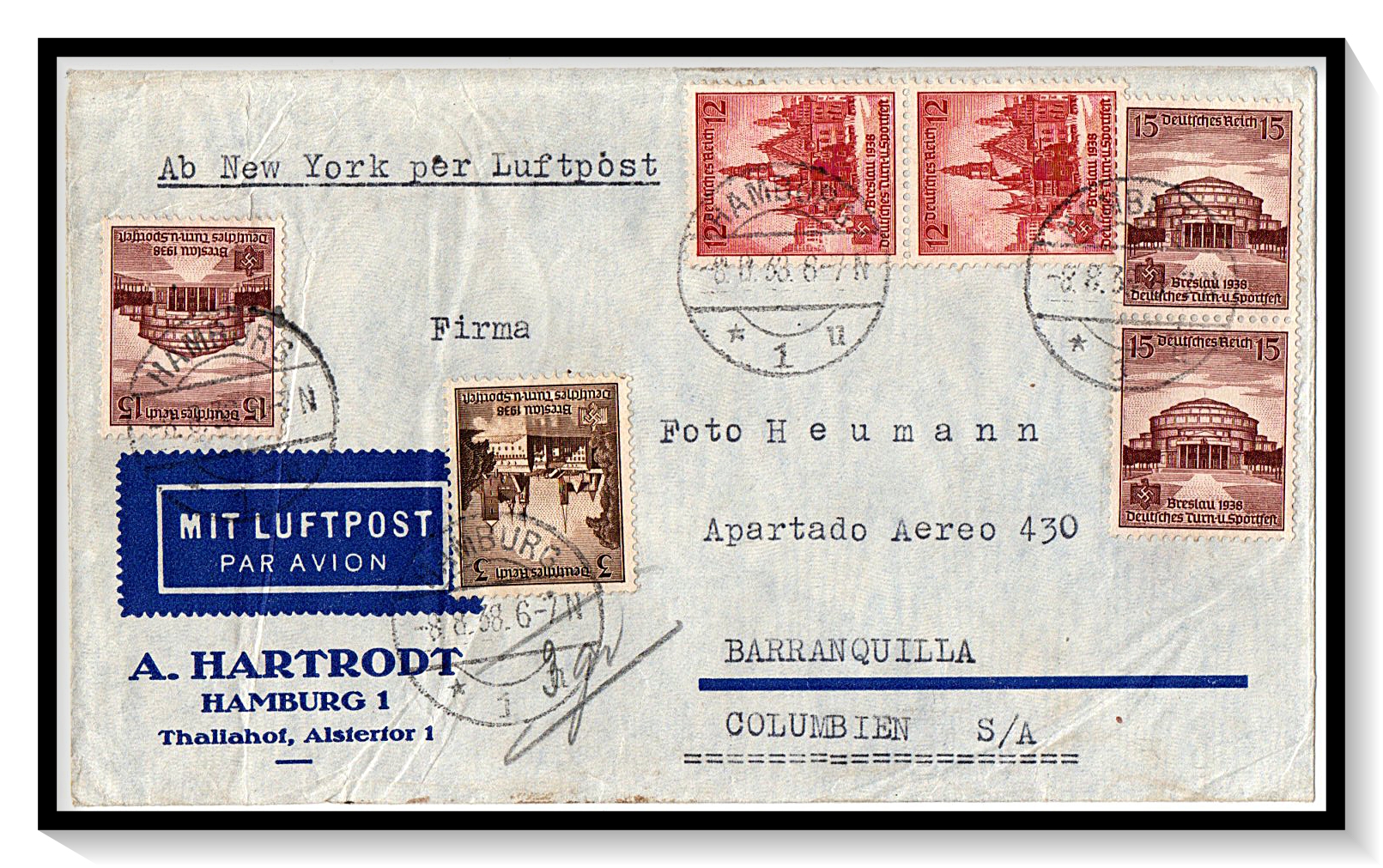
Foto Heumann: German-Colombian Photography Studio in 1938

Date of use : 1938, Germany

Foto Heumann: German-Colombian Photography Studio in 1938

This envelope represents a significant postal document reflecting the commercial and technical communication networks established between Europe and South America during the early 20th century. The sender, A. Hartrodt, was a Hamburg-based logistics and transportation company. Founded in the late 19th century, the firm operated primarily in maritime transport and international freight organization. Given Hamburg's central role in global trade networks, such companies played a crucial role in facilitating the movement of goods and information between Europe and the American continents.
The recipient, identified as "Foto Heumann," was located in Barranquilla, Colombia. As a major Caribbean port city, Barranquilla emerged in the first half of the 20th century as one of the country's key commercial and distribution centers. The firm was most likely founded and operated by a photographer of German origin, Erwin Heumann. Its activities extended beyond conventional studio work, focusing particularly on urban landscapes and the visual documentation of the city. This suggests that the enterprise combined commercial photography with a documentary-oriented approach, contributing to the visual construction of urban identity.
The inscription "Ab New York per Luftpost" indicates that the item was routed via New York and transported by airmail. This detail highlights the multi-stage nature of transatlantic postal routes during the period. Mail originating in Europe was often directed first to North America before being forwarded to South America, reflecting the structure of early global airmail networks. Such routes were commonly used by businesses requiring faster communication.
The presence of the "Mit Luftpost / Par Avion" label clearly designates the item as airmail. German postage stamps and cancellations confirm that the envelope was processed through the official postal system under regulated tariffs. The arrival postmark from Barranquilla, dated August 1938, indicates successful delivery. Additional control markings suggest that the envelope underwent standard inspection procedures.
Within its broader economic context, this document demonstrates that the photographic and optical industries were not confined to local markets but were integrated into global trade networks. Photographic equipment and materials produced in Europe were exported to developing markets such as Latin America, creating multi-layered commercial connections between logistics firms, producers, and regional distributors.
Record Information
Title: Foto Heumann: German-Colombian Photography Studio in 1938
Category: Photographic Industry History / International Trade
Subcategory: Transatlantic Airmail / Studio Documentation
Country: Germany (Origin) → Colombia (Destination) (via USA) 🗺️ Show Route
City: Hamburg → Barranquilla (routed through New York)
Date of use: 1938 (arrival in Barranquilla: August 1938)
Company (Sender): A. Hartrodt, Hamburg - logistics and transportation company, founded late 19th century, specializing in maritime transport and international freight.
Company (Recipient): Foto Heumann, Barranquilla, Colombia. Studio founded by Erwin Heumann (German origin). Specialized in commercial photography and urban landscape documentation.
Object Type: International airmail cover ("Mit Luftpost / Par Avion")
Postal Route ✈️🚢: Hamburg, Germany → New York, USA → Barranquilla, Colombia (1938 Transatlantic Route)
Estimated Travel Time: Approximately 7-10 days (Hamburg → New York: 3-5 days by air/sea, New York → Barranquilla: 2-4 days by air)
Postal Features: "Mit Luftpost / Par Avion" label, "Ab New York per Luftpost" routing instruction, German stamps and cancellations, Barranquilla arrival postmark (August 1938), control/inspection markings
Language: German, Spanish
Material: Paper envelope
Dimensions: Standard envelope format
Collection Theme: German-Latin American photographic trade, Erwin Heumann studio history, Barranquilla commercial photography, transatlantic airmail development, 1930s logistics networks, urban visual documentation
Archival Significance: This 1938 airmail cover documents the connection between German logistics firm A. Hartrodt and the Barranquilla-based studio Foto Heumann, founded by German photographer Erwin Heumann. The routing "Ab New York per Luftpost" and arrival postmark provide precise evidence of early airmail infrastructure. This item is a primary source for understanding how European photographic expertise and commerce reached South American markets in the 1930s.
Research Note:
This article is based on historical research and independent analysis of the material in the author's collection. The text has been prepared as an original interpretative study and does not reproduce copyrighted material.
This item is documented as part of the Photography in Postal History research project.
For research context, see the Research Methodology.
For academic reference, please refer to How to Cite This Archive.

Saturday, 3 September 2022

Photographer Edwin N. Peabody (1846–1920)

Date of use : 1880, USA

Photographer Edwin N. Peabody (1846–1920)

This envelope represents a piece of commercial and personal correspondence associated with a landscape photographer operating in the United States. The printed letterhead on the upper left side reads "Edwin N. Peabody, Landscape Photographer, 280½ Essex St., Salem, Mass." This inscription identifies the sender as Edwin N. Peabody and indicates his professional specialization in landscape photography. The practice of photographing landscapes developed into both an artistic and commercial field in the United States during the late nineteenth century. Images of natural scenery, coastal views, and urban panoramas were widely reproduced as postcards, photographic prints, and exhibition photographs.
Peabody's studio was located in the city of Salem, Massachusetts, a historic port community with a strong commercial and cultural background. During the late nineteenth and early twentieth centuries the city attracted photographers because of its distinctive architecture, maritime heritage, and surrounding coastal scenery. Photographers working in Salem often produced images for both local residents and visitors interested in visual souvenirs of the region. The explicit designation "landscape photographer" suggests that Peabody concentrated primarily on outdoor imagery rather than studio portraiture.
The postal cancellation on the envelope indicates Salem, Massachusetts, in the month of November. Although the exact year is difficult to read, the postage stamps attached to the envelope point to a date in the late nineteenth century or the early years of the twentieth century. Two United States stamps appear on the cover: one valued at one cent and another at two cents. The combined use of stamps in this way reflects the postal rate structure of the period and demonstrates how postage fees were often assembled using multiple denominations.
The envelope is addressed to Mr. Henry O. Peabody in Boston, Massachusetts. The shared surname suggests the possibility of a family relationship between sender and recipient; however, without further documentary evidence this remains only a plausible interpretation. Boston functioned as one of the principal commercial and cultural centers of New England and also supported an active photographic community. The correspondence may therefore have involved either personal communication or matters related to photographic work.
Another notable element printed on the envelope is the instruction "If not delivered within ten days return to…" followed by the sender's address. Such return notices were commonly used in business correspondence to ensure that undelivered mail could be redirected back to the sender. This practice formed part of the reliability measures built into the American postal system during the period.
From a philatelic standpoint the envelope illustrates characteristic features of American postal practice in the era. The circular cancellation mark, the combination of stamp denominations, and the printed professional letterhead together form a visually distinctive postal artifact. Letterheads of this type functioned not only as practical identification but also as a subtle form of advertising, presenting the sender's professional identity and address to recipients.
Within a collecting context the envelope can be classified as photographic commercial ephemera. Letterhead covers from photographers represent valuable documentary sources for reconstructing the professional networks and communication practices of early photographic practitioners. They provide insight into how photographers maintained contact with clients, colleagues, and family members through the postal system.
Record Information
Title: Edwin N. Peabody Photographer Business Envelope (Salem to Boston)
Category: Photographic Studios / Commercial Correspondence
Subcategory: 19th Century American Landscape Photography / Regional Networks
Country: USA (Sender: Salem, MA) → USA (Recipient: Boston, MA)
City: Salem, Massachusetts (Sender: Edwin N. Peabody) → Boston, Massachusetts (Recipient: Henry O. Peabody)
Date of use: c. 1880
Photographer (Sender): Edwin N. Peabody (1846–1920), Landscape Photographer, 280½ Essex Street, Salem, Massachusetts, USA. A professional photographer specializing in landscape imagery of coastal scenery, architecture, and natural views in the New England region.
Object Type: Commercial envelope (business correspondence with printed letterhead)
Postal Features: US 1-cent and 2-cent postage stamps; Salem, Massachusetts postal cancellation (November, c. 1880); "If not delivered within ten days return to..." return instruction.
Language: English
Material: Paper envelope
Dimensions: Standard commercial envelope format
Collection Theme: Edwin N. Peabody, Salem photography, landscape photographers, 19th century American photography, Massachusetts photographers, Boston correspondence, Henry O. Peabody, Essex Street, postal return instructions, 1880s US postal history.
Archival Significance: This c. 1880 envelope documents correspondence from Salem landscape photographer Edwin N. Peabody to Boston, illustrating the professional and personal networks of 19th-century American photographers and featuring the printed letterhead of a specialist landscape practitioner in historic Salem, Massachusetts.
Research Note:
This article is based on historical research and independent analysis of the material in the author's collection. The text has been prepared as an original interpretative study and does not reproduce copyrighted material.
This item is documented as part of the Photography in Postal History research project.
For research context, see the Research Methodology.
For academic reference, please refer to How to Cite This Archive.

Tuesday, 26 July 2022

Arthur Benda and Studio d'Ora Legacy

Date of use : 1928, Austria

Arthur Benda and Studio d'Ora Legacy

This postcard documents a professional exchange between a photographic studio in Vienna and a newspaper editorial office in Prague. The typed text on the reverse indicates that the message was written in Vienna on 29 March 1928. The sender is identified by a stamp reading "d'Ora – Arthur Benda," which connects the correspondence to the renowned Viennese photographic studio Studio d'Ora. The studio was founded by Dora Kallmus (1881–1963), a pioneering photographer who gained international recognition as one of the first prominent female professionals in the field of portrait photography. Established in Vienna in 1907, the studio quickly achieved prestige among aristocratic circles, artists, and members of the cultural elite.
The name Arthur Benda (1883–1969) appearing on the card refers to a key collaborator within the studio. Benda worked closely with Dora Kallmus and became an important figure in the creative and commercial operations of the atelier. After the First World War the reputation of Studio d'Ora expanded significantly, and the studio developed extensive professional connections throughout Europe, including Paris and other cultural centers. Arthur Benda was particularly known for his portrait photography and contributed to many images associated with the distinctive style of the studio.
The postcard is addressed to the editorial department of "Das Leben" at the newspaper Prager Tagblatt. This newspaper, published in Prague in the German language, occupied an influential position within the intellectual and cultural environment of Central Europe. It regularly featured coverage of artistic and cultural topics and reached a broad readership. For photographic studios of the period, newspapers represented important channels through which portraits and visual material could circulate publicly.
The message itself confirms the return of photographs previously sent to the editorial office and notes that the editors retained image number 3316, titled "Hübel." This indicates that the studio had provided photographic material to the newspaper for potential publication. Images distributed in this way were often used to illustrate cultural articles, portraits of notable personalities, or features related to the arts. The postcard therefore reflects not only a courteous acknowledgment but also the practical workings of cooperation between photographic studios and the press.
Postal elements on the card include Austrian stamps and cancellation marks, indicating that the item was processed within the Austrian postal network and dispatched from Vienna. The layout follows the standard design used for official postcards in Central Europe during the interwar period. Such postcards offered a convenient and economical means of transmitting brief professional messages.
From a collecting perspective, this document holds significance in several areas. It is directly connected with Studio d'Ora, an institution of considerable importance in the history of portrait photography. At the same time, it provides insight into the relationship between photography and the press during the interwar years. Finally, it represents a piece of postal history illustrating communication between Austria and Czechoslovakia.
Record Information
Title: Studio d'Ora / Arthur Banda Business Postcard (Vienna to Prague)
Category: Photographic Studios / Press Relations
Subcategory: Austrian Portrait Photography / Cultural Journalism
Country: Austria (Sender: Vienna) → Czechoslovakia (Recipient: Prague)
City: Vienna (Sender: Studio d'Ora / Arthur Benda) → Prague (Recipient: Prager Tagblatt / Das Leben)
Date of use: 29 March 1928
Studio (Sender): Studio d'Ora (Dora Kallmus) and Arthur Benda, Vienna, Austria. A renowned Viennese portrait photography studio founded in 1907 by Dora Kallmus, one of the first prominent female professional photographers. Arthur Benda (1883–1969) was a key collaborator and photographer associated with the studio.
Object Type: Commercial postcard (business correspondence with newspaper)
Postal Features: Austrian postage stamps; Vienna postal cancellation (29 March 1928).
Language: German
Material: Paper (postcard stock)
Dimensions: Standard postcard format
Collection Theme: Studio d'Ora, Dora Kallmus, Arthur Benda, Viennese portrait photography, Prager Tagblatt, Das Leben, Austrian-Czech press relations, interwar photography, photographer-press cooperation, cultural journalism, image distribution, Central European postal history.
Archival Significance: This 1928 postcard documents professional correspondence between the renowned Viennese portrait studio d'Ora (Arthur Benda) and the Prague German-language newspaper Prager Tagblatt, illustrating the collaboration between photographic studios and the press in the distribution of cultural imagery during the interwar period.
Research Note:
This article is based on historical research and independent analysis of the material in the author's collection. The text has been prepared as an original interpretative study and does not reproduce copyrighted material.
This item is documented as part of the Photography in Postal History research project.
For research context, see the Research Methodology.
For academic reference, please refer to How to Cite This Archive.

Friday, 17 December 2021

Photographic Studio Stationery of Clément Ortmans, Belgium

Date of use : 1936, Belgium

Photographic Studio Stationery of Clément Ortmans, Belgium

This document represents a commercial envelope issued by the company Clément Ortmans (1881-1964), a photographic supply distributor based in the Belgian city of Verviers. The printed letterhead prominently features the French phrase "Fournitures Photographiques en gros," meaning "wholesale photographic supplies." This description clearly indicates that the firm operated as a distributor of photographic materials such as cameras, accessories, chemicals, and related equipment.
According to the printed information on the envelope, the company's primary base of operations was located in Verviers. Additional telephone connections are listed for the cities of Antwerp and Liège, suggesting that the business maintained commercial relationships or representative contacts in several Belgian urban centers. During the early twentieth century the distribution of photographic materials in Belgium often relied on regional networks of wholesalers and retail dealers.
In the upper right corner of the envelope appears a Belgian postage stamp with a denomination of 70 centimes, bearing the portrait of King Leopold III. This stamp belongs to one of the standard postal issues used in Belgium during the 1930s. The cancellation mark indicates processing through the Verviers postal system and dates the mailing to the year 1936. This period coincided with a phase of rapid growth in the photographic industry, when amateur photography was becoming increasingly widespread across Europe.
The envelope was addressed to Monsieur and Madame Alfred Deftize in the city of Liège. The address references Place Xavier Neujean, a well-known square located in the central area of the city. The correspondence was most likely related to a commercial matter such as a product order, catalogue mailing, or delivery of photographic materials. However, because the original contents of the envelope are no longer present, the exact purpose of the correspondence cannot be determined with certainty.
Belgium played an important role in the European photographic trade during the first half of the twentieth century. Situated between major industrial centers in Germany and France, the country functioned as a commercial intermediary within the broader photographic market. Photographic shops and wholesalers operating in cities such as Brussels, Antwerp, and Liège often served as distributors for equipment produced by international manufacturers. Firms like Clément Ortmans likely formed part of this interconnected commercial network.
From a postal history perspective the envelope reflects the visual characteristics typical of business correspondence in the 1930s. The printed commercial letterhead, the listing of telephone numbers, and the clear identification of branch contacts illustrate the modern communication practices adopted by businesses of the period. Envelopes of this kind functioned not only as carriers of mail but also as subtle advertising media representing the company's identity.
For collectors, the envelope may be classified within several thematic fields. It belongs to the category of photographic industry ephemera because it originates from a company specializing in photographic supplies. At the same time it contributes to the study of Belgian postal history, commercial correspondence, and the broader European networks that supported the distribution of photographic technology.
Record Information
Title: Photographic Studio Stationery of Clément Ortmans, Belgium
Category: Photographic Industry History / Wholesale Trade
Subcategory: Commercial Correspondence / Belgian Postal History
Country: Belgium
City: Verviers (Sender) → Liège (Recipient)
Date of use: 1936
Company (Sender): Clément Ortmans (1881-1964), Verviers, Belgium. A wholesale distributor of photographic supplies, including cameras, accessories, chemicals, and related equipment, operating in Belgium during the early twentieth century.
Recipient: Monsieur and Madame Alfred Deftize, Place Xavier Neujean, Liège, Belgium.
Object Type: Domestic commercial envelope with printed letterhead
Postal Features: Belgian 70-centime stamp with King Leopold III portrait; Verviers postal cancellation (1936).
Language: French
Material: Paper envelope
Dimensions: Standard envelope format
Notable Feature: Printed letterhead identifying the firm as "Fournitures Photographiques en gros" (wholesale photographic supplies); telephone connections listed for Verviers, Antwerp, and Liège; King Leopold III postage stamp.
Collection Theme: Clément Ortmans, Verviers, Belgian photographic trade, wholesale photographic supplies, Liège photography, King Leopold III stamp, Belgian postal history, commercial correspondence, 1930s Europe.
Archival Significance: This 1936 envelope documents a Belgian wholesale photographic supply distributor, illustrating the commercial networks that supported the photographic industry in interwar Belgium.
Research Note:
This article is based on historical research and independent analysis of the material in the author's collection. The text has been prepared as an original interpretative study and does not reproduce copyrighted material.
This item is documented as part of the Photography in Postal History research project.
For research context, see the Research Methodology.
For academic reference, please refer to How to Cite This Archive.

Wednesday, 8 December 2021

Alois Koestler Studio Cover, Munich, Germany

Date of use : c.1920, Germany

Alois Koestler Studio Cover, Munich, Germany

This document represents a commercial mailing envelope associated with the photographic studio Photographisches Atelier Alois Koestler, which operated in the city of Munich, Germany. The printed letterhead at the top of the envelope includes the name of the studio together with its telephone number and street address. The line "Telefon-Ruf 21307" indicates that the business maintained a telephone connection, illustrating the growing integration of modern communication technologies into commercial activity during the early twentieth century.
The sender identified on the envelope, Photographisches Atelier Alois Koestler, operated at Bürklein-Straße 10 in Munich. During the late nineteenth and early twentieth centuries, independent photographic studios became common features of European urban life. These studios typically offered portrait photography, family photographs, and official identification images. In a cultural center such as Munich, a photographic studio would likely have served both local residents and members of the city's artistic and professional communities.
The typography and layout of the printed letterhead reflect the commercial design conventions of the period. The name of the studio is displayed prominently in large type, while the address and telephone details appear in a smaller but clearly legible format. This design approach represents an early form of visual corporate identity used by businesses to establish a recognizable presence in written correspondence.
The postage stamp located in the upper right corner bears the inscription "Deutsches Reich" and displays a Bavarian heraldic motif. The stamp carries a denomination of forty pfennig. Such stamps formed part of the official postal issues used within the German Reich postal system. The cancellation mark applied to the stamp indicates processing within the Munich postal network.
The handwritten address suggests that the envelope was directed to an individual or business located in Munich. Part of the address appears to contain the word "Schaehalles München," although the handwriting is not entirely clear. Because some parts of the script are difficult to read, the exact identity of the recipient cannot be determined with certainty.
From the perspective of commercial history, envelopes of this type provide valuable insight into the everyday operations of photographic studios. Such businesses relied on written correspondence for handling portrait orders, communicating with suppliers, and maintaining contact with clients. Printed envelopes bearing the studio's letterhead served as an important instrument of professional communication.
In terms of postal history, the envelope illustrates the role of the German postal system as a central infrastructure supporting small commercial enterprises. The availability of reliable postal services enabled photography studios and other service-based businesses to maintain regular contact with customers and business partners.
From a collecting standpoint, this envelope may be categorized as photographic industry ephemera. Letterhead envelopes from photographic studios constitute primary documentary evidence of the commercial activities associated with photography. They also offer insight into the presence and distribution of local photographic businesses within European urban environments.
Record Information
Title: Alois Koestler Studio Cover, Munich, Germany
Category: Photographic Industry History / Studio Photography
Subcategory: Commercial Correspondence / Urban Business Networks
Country: Germany
City: Munich
Date of use: c.1920
Company (Sender): Photographisches Atelier Alois Koestler, Bürklein-Straße 10, Munich, Germany. A photographic studio operating in Munich, offering portrait photography, family photographs, and official identification images to local residents and the city's artistic and professional communities.
Object Type: Domestic commercial envelope with printed letterhead
Postal Features: German 40-pfennig "Deutsches Reich" stamp with Bavarian heraldic motif; Munich postal cancellation.
Language: German
Material: Paper envelope
Dimensions: Standard envelope format
Notable Feature: Printed letterhead with telephone number "Telefon-Ruf 21307" reflecting modern communication integration; Bavarian heraldic motif on stamp; prominent typographic design for corporate identity.
Collection Theme: Alois Koestler, Munich photography, German photographic studios, portrait photography, urban business networks, Deutsches Reich stamps, Bavarian heraldry, commercial correspondence, 1920s Germany.
Archival Significance: This 1920 envelope documents a Munich-based photographic studio's business correspondence, illustrating the professional communication practices and urban commercial networks of the German photographic industry in the early Weimar Republic.
Research Note:
This article is based on historical research and independent analysis of the material in the author's collection. The text has been prepared as an original interpretative study and does not reproduce copyrighted material.
This item is documented as part of the Photography in Postal History research project.
For research context, see the Research Methodology.
For academic reference, please refer to How to Cite This Archive.

Thursday, 14 January 2021

Photographie Victoire Studio Business Stationery

Date of use : circa 1900-1910, France

Photographie Victoire Studio Business Stationery

This document is a commercial envelope that reflects the visual identity and international communication networks of photographic studios in Europe during the late nineteenth and early twentieth centuries. The elaborate typographic and decorative emblem printed on the left side identifies the sender as a photographic studio named "Photographie Victoire." The address 22 Rue Paul Chenavard, Lyon is printed within the design. During the nineteenth century Lyon developed into one of France's major commercial and cultural centers, and the city became home to numerous photographic studios that served both local clients and a broader regional market.
The graphic composition printed on the envelope illustrates the elaborate design practices commonly used by commercial photography studios during the period. The name "Photographie Victoire" appears within a heraldic emblem surrounded by decorative motifs and stylized rays that evoke the symbolism of light associated with photography. Such ornate visual presentations were particularly characteristic of the Belle Époque period, when photographic studios frequently employed elaborate branding in their printed materials.
The emblem also contains the phrase "6 Médailles d'Or – Membre du Jury," which indicates that the studio claimed to have received multiple gold medals and to have participated as a jury member in photographic exhibitions or competitions. During the late nineteenth and early twentieth centuries, photographic studios often highlighted awards received at national or international exhibitions as part of their promotional identity. Displaying medals and honors in stationery and studio advertisements served to enhance professional credibility and attract clients.
The exact founding date of Photographie Victoire and the identity of its founder are not indicated on the envelope itself. Nevertheless, historical patterns suggest that many photographic studios in Lyon emerged during the final decades of the nineteenth century as portrait photography expanded across European cities. It is therefore plausible that this studio originated during that period as a commercial portrait photography establishment. The address on Rue Paul Chenavard is located near the historic center of Lyon, an area that historically hosted various commercial enterprises.
The presence of the word "Éditeur" within the printed design suggests that the studio may also have been involved in publishing photographic prints or postcards. Many photographic studios diversified their activities by producing portrait cards, souvenir photographs, and illustrated postcards, which became an important segment of the visual culture of the period.
The envelope is addressed to Monsieur Dierckx-Beke at 19 rue Bailles (or a similar spelling), Malines, Belgium. Malines—known today primarily by its Flemish name Mechelen—is a historic city located between Brussels and Antwerp. During the late nineteenth and early twentieth centuries the city functioned as an important regional center for trade and craftsmanship. The professional background of the recipient is not specified on the envelope. However, the fact that the correspondence originated from a photographic studio suggests that the recipient may have been a client, a business associate, a supplier of photographic materials, or possibly another professional connected to the photographic trade. This interpretation remains speculative due to the limited available information.
The envelope bears two French postage stamps depicting Marianne, the symbolic representation of the French Republic. Stamps featuring this allegorical figure were widely used in France during the late nineteenth and early twentieth centuries. The postal cancellation clearly indicates Lyon, confirming the place of origin of the letter. Postal exchanges between France and Belgium during this period were efficient and regular, supported by the extensive railway networks that connected major European cities.
Such envelopes represent important artifacts not only for postal history but also for the history of commercial graphic design and visual culture. Photographic studios frequently invested considerable effort in the design of their stationery to strengthen brand identity and project professional prestige. As a result, the decorative elements visible on this envelope provide valuable insight into the aesthetic conventions of commercial printing during the Belle Époque.
From a collecting perspective this envelope can be associated with several thematic categories. It is particularly relevant for collections focused on photographic studio stationery and the history of photography businesses. In addition, it may be included in collections related to France–Belgium postal history, Belle Époque commercial graphic design, international business correspondence, and advertising strategies of photographic studios.
In conclusion, this envelope demonstrates that photographic studios in Europe functioned not only as artistic enterprises but also as commercial actors participating in international communication networks. The correspondence between a studio in Lyon and a recipient in Belgium suggests that photographic businesses operated within cross-border professional and commercial relationships. As such, this document should be understood not merely as a postal artifact but also as a small yet meaningful witness to the economic and cultural networks that shaped the photographic industry during the early twentieth century.
Record Information
Title: Photographie Victoire Studio Business Stationery
Category: Photographic History / Portrait Studios
Subcategory: Commercial Correspondence / Belle Époque Branding
Country: France (Sender: Lyon) → Belgium (Recipient: Malines) 🗺️ Show Route
City: Lyon (Sender: Photographie Victoire) → Malines (Mechelen) (Recipient: Monsieur Dierckx-Beke)
Date of use: circa 1900-1910
Studio (Sender): Photographie Victoire, 22 Rue Paul Chenavard, Lyon. A French photographic studio active around the turn of the 20th century, likely specializing in portraits and possibly publishing prints/postcards ("Éditeur"). Claimed "6 Médailles d'Or – Membre du Jury," indicating awards and professional recognition.
Recipient: Monsieur Dierckx-Beke, 19 rue Bailles, Malines, Belgium. Likely a client, business associate, or supplier.
Object Type: International commercial envelope
Postal Route 🚂📮 (Estimated Route): Lyon, France → Malines (Mechelen), Belgium (c.1900-1910)
Estimated Travel Time: Approximately 1-2 days (railway via Dijon, Paris, Brussels)
Postal Features: Two French Marianne definitive stamps; Lyon postal cancellation.
Notable Design: Elaborate Belle Époque heraldic emblem with decorative motifs, rays symbolizing light, and award inscriptions.
Language: French
Material: Paper envelope
Dimensions: Standard envelope format
Collection Theme: Photographie Victoire, Lyon photography, Belle Époque graphic design, French studio stationery, Marianne stamps, France-Belgium postal history, photographic awards and medals, international commercial networks.
Archival Significance: This circa 1900-1910 envelope documents the international correspondence of a Lyon photographic studio, its elaborate branding reflecting Belle Époque commercial aesthetics and professional recognition through medals.
Research Note:
This article is based on historical research and independent analysis of the material in the author's collection. The text has been prepared as an original interpretative study and does not reproduce copyrighted material.
This item is documented as part of the Photography in Postal History research project.
For research context, see the Research Methodology.
For academic reference, please refer to How to Cite This Archive.