Showing posts with label CommercialPhotography. Show all posts

Friday, 2 August 2024

Foto Heumann: German-Colombian Photography Studio in 1938

Date of use : 1938, Germany

Foto Heumann: German-Colombian Photography Studio in 1938

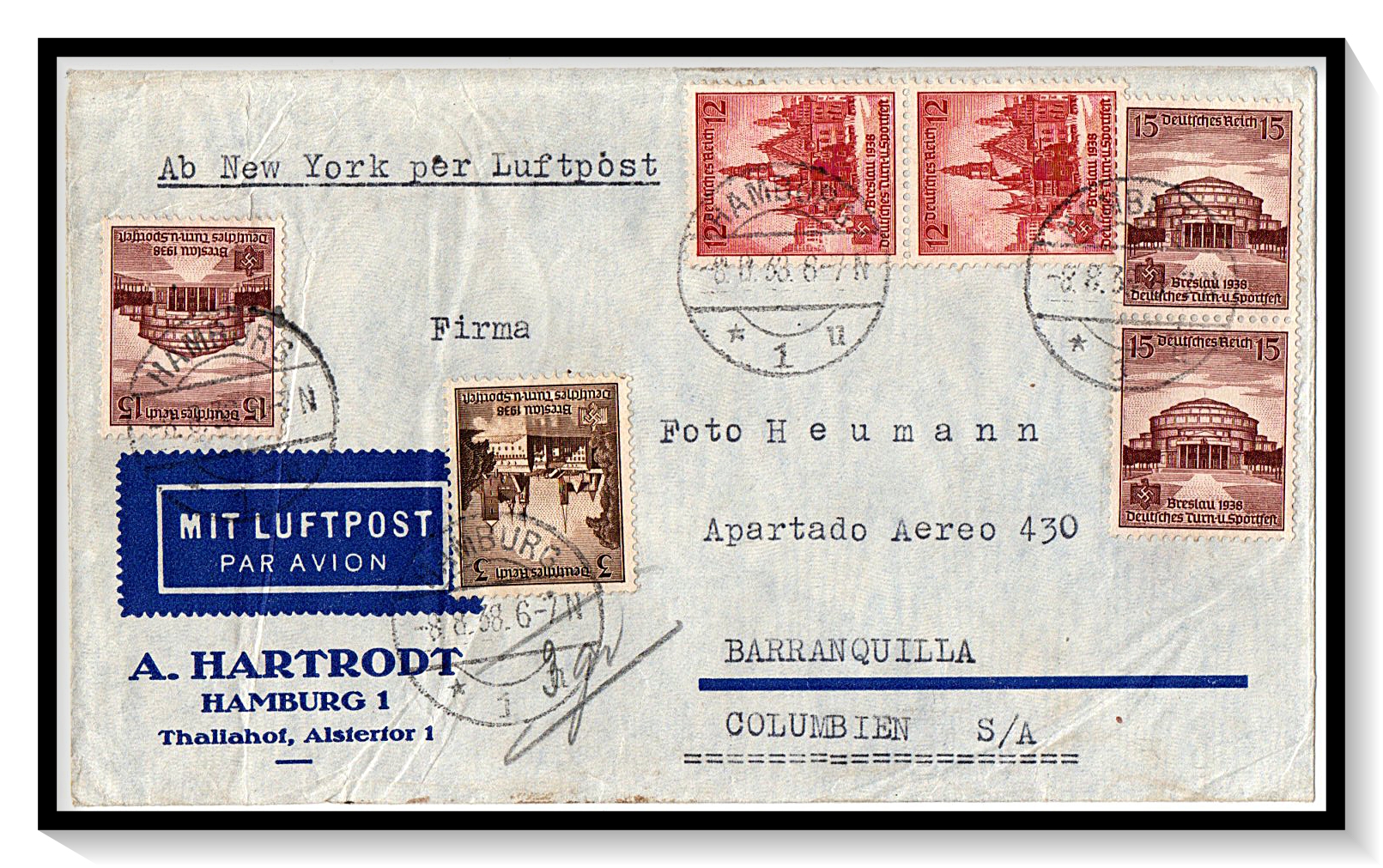
This envelope represents a significant postal document reflecting the commercial and technical communication networks established between Europe and South America during the early 20th century. The sender, A. Hartrodt, was a Hamburg-based logistics and transportation company. Founded in the late 19th century, the firm operated primarily in maritime transport and international freight organization. Given Hamburg's central role in global trade networks, such companies played a crucial role in facilitating the movement of goods and information between Europe and the American continents.
The recipient, identified as "Foto Heumann," was located in Barranquilla, Colombia. As a major Caribbean port city, Barranquilla emerged in the first half of the 20th century as one of the country's key commercial and distribution centers. The firm was most likely founded and operated by a photographer of German origin, Erwin Heumann. Its activities extended beyond conventional studio work, focusing particularly on urban landscapes and the visual documentation of the city. This suggests that the enterprise combined commercial photography with a documentary-oriented approach, contributing to the visual construction of urban identity.
The inscription "Ab New York per Luftpost" indicates that the item was routed via New York and transported by airmail. This detail highlights the multi-stage nature of transatlantic postal routes during the period. Mail originating in Europe was often directed first to North America before being forwarded to South America, reflecting the structure of early global airmail networks. Such routes were commonly used by businesses requiring faster communication.
The presence of the "Mit Luftpost / Par Avion" label clearly designates the item as airmail. German postage stamps and cancellations confirm that the envelope was processed through the official postal system under regulated tariffs. The arrival postmark from Barranquilla, dated August 1938, indicates successful delivery. Additional control markings suggest that the envelope underwent standard inspection procedures.
Within its broader economic context, this document demonstrates that the photographic and optical industries were not confined to local markets but were integrated into global trade networks. Photographic equipment and materials produced in Europe were exported to developing markets such as Latin America, creating multi-layered commercial connections between logistics firms, producers, and regional distributors.
Record Information
Title: Foto Heumann: German-Colombian Photography Studio in 1938
Category: Photographic Industry History / International Trade
Subcategory: Transatlantic Airmail / Studio Documentation
Country: Germany (Origin) → Colombia (Destination) (via USA) 🗺️ Show Route
City: Hamburg → Barranquilla (routed through New York)
Date of use: 1938 (arrival in Barranquilla: August 1938)
Company (Sender): A. Hartrodt, Hamburg - logistics and transportation company, founded late 19th century, specializing in maritime transport and international freight.
Company (Recipient): Foto Heumann, Barranquilla, Colombia. Studio founded by Erwin Heumann (German origin). Specialized in commercial photography and urban landscape documentation.
Object Type: International airmail cover ("Mit Luftpost / Par Avion")
Postal Route ✈️🚢: Hamburg, Germany → New York, USA → Barranquilla, Colombia (1938 Transatlantic Route)
Estimated Travel Time: Approximately 7-10 days (Hamburg → New York: 3-5 days by air/sea, New York → Barranquilla: 2-4 days by air)
Postal Features: "Mit Luftpost / Par Avion" label, "Ab New York per Luftpost" routing instruction, German stamps and cancellations, Barranquilla arrival postmark (August 1938), control/inspection markings
Language: German, Spanish
Material: Paper envelope
Dimensions: Standard envelope format
Collection Theme: German-Latin American photographic trade, Erwin Heumann studio history, Barranquilla commercial photography, transatlantic airmail development, 1930s logistics networks, urban visual documentation
Archival Significance: This 1938 airmail cover documents the connection between German logistics firm A. Hartrodt and the Barranquilla-based studio Foto Heumann, founded by German photographer Erwin Heumann. The routing "Ab New York per Luftpost" and arrival postmark provide precise evidence of early airmail infrastructure. This item is a primary source for understanding how European photographic expertise and commerce reached South American markets in the 1930s.
Research Note:
This article is based on historical research and independent analysis of the material in the author's collection. The text has been prepared as an original interpretative study and does not reproduce copyrighted material.
This item is documented as part of the Photography in Postal History research project.
For research context, see the Research Methodology.
For academic reference, please refer to How to Cite This Archive.

Saturday, 27 August 2022

McIntyre Photo Co.: Commercial Photography & Photo Finishing

Date of use : 1928, USA

McIntyre Photo Co.: Commercial Photography & Photo Finishing

This envelope is an original piece of commercial correspondence dating from 1928 and represents an authentic postal history artifact documenting the activities of a photographic company operating in the United States. The printed corner card in the upper left clearly identifies the sender as McIntyre Photo Co., Commercial Photography and Photo Finishing, 181½ Main Street, Warren, Ohio.

The printed heading indicates that the company was not merely a portrait photography studio but also offered commercial photography and photographic finishing services. In the terminology of the photographic industry during the early twentieth century, the term Photo Finishing referred to the professional processing of photographic negatives, the production of photographic prints, retouching, and the preparation of enlargements for customers.

During the 1920s, Warren, Ohio was one of the region's important industrial centers, with an economy largely based on metalworking, machinery manufacturing, and the rapidly expanding automotive supply industry. Photographic studios operating in such industrial communities were engaged in far more than portrait photography alone. They frequently documented factories, produced catalogue illustrations, created advertising photographs, and supplied visual material for commercial promotion. The explicit use of the phrase Commercial Photography on the envelope strongly suggests that McIntyre Photo Co. specialized in this type of professional work.

Archival records and local historical sources indicate that Bruce R. McIntyre (1888–1962) operated a photographic studio on Main Street in Warren, Ohio for many years. He worked extensively for local newspapers, commercial businesses, and industrial firms, and a collection of his photographs has been preserved in local archives. It is therefore highly probable that the addressee of this envelope, B. R. McIntyre, and Bruce R. McIntyre, proprietor of McIntyre Photo Co., were the same individual. The identical surname, the shared connection with Warren, Ohio, and the photographic profession all support this conclusion. Nevertheless, since the envelope alone cannot conclusively establish the recipient's identity, this interpretation should be regarded as a well-supported but cautious assessment.

The front of the envelope bears a postmark reading Cleveland, Ohio, November 13, 1928, 12:00 PM. Although the sender was located in Warren, the letter was processed through Cleveland, which served as the principal postal distribution center for northern Ohio during this period. Consequently, the routing of the correspondence through Cleveland represents a perfectly normal practice within the contemporary postal system. The five-cent postage stamp corresponds to the standard domestic first-class postal rate in the United States at that time.

The envelope is addressed to B. R. McIntyre, General Delivery, Dayton, Ohio. Within the American postal system, General Delivery was a special service intended for individuals who did not have a permanent mailing address or who were temporarily residing in another city. Mail addressed in this manner was retained at the local post office until collected personally by the recipient upon identification. During the 1920s this service was widely used by travelling businessmen, sales representatives, exhibitors attending trade fairs, and professionals working temporarily away from their home communities. The use of this address therefore suggests that B. R. McIntyre was temporarily present in Dayton during November 1928.

The reverse of the envelope provides additional evidence regarding its postal journey. A clear receiving postmark reads Dayton, Ohio, November 14, 1928, 7:30 AM, demonstrating that the letter reached the Dayton Post Office on the morning following its dispatch from Cleveland. Adjacent to the receiving postmark is an oval black handstamp containing the numeral "3," which most likely represents an internal postal routing or sorting mark used by the Dayton Post Office. Such numbered handstamps were commonly employed to facilitate the internal handling and distribution of mail.

Beneath this appears a partially struck purple handstamp from which the words DAYTON, GEN. DEL., and NOV 14remain legible. This marking confirms that the envelope was processed by the General Delivery section of the Dayton Post Office and directly corroborates the address appearing on the front of the envelope.

Several pencil annotations made by earlier collectors or researchers are also present. On the front, the handwritten notes "1st Flight," "Cleveland," and "Louisville" can be identified. On the reverse, the annotations "CAM 16?" and "no landing" are clearly visible, while the third line most probably reads "anywhere," although it cannot be deciphered with complete certainty. These annotations are not official postal markings but rather personal research notes added by previous collectors examining the postal history of the item.

The notation "CAM 16?" is of particular interest. In the United States, CAM (Contract Air Mail) route numbers were introduced following the Contract Air Mail Act of 1925 and were assigned to airmail routes operated by private contractors beginning in 1926. The question mark accompanying the notation clearly indicates that the previous collector regarded the possible association with Contract Air Mail Route 16 as speculative rather than established fact. Since the envelope bears no official airmail endorsement, cachet, or postal marking confirming transportation by air, the notation should be regarded solely as a research hypothesis and not as evidence of actual carriage via CAM Route 16.

Perhaps the most remarkable characteristic of this envelope is that it has never been opened despite the passage of nearly a century. The original flap remains intact, and the letter or other enclosure has remained undisturbed since it was originally sealed in 1928. As a result, the envelope preserves not only its external appearance but also the original commercial correspondence contained within. From the perspectives of photographic history, business history, and postal history, unopened commercial covers of this type are especially significant because they retain their documentary integrity in its original state.

The McIntyre Photo Co. envelope is therefore much more than an ordinary piece of business correspondence. It serves as an important historical document illustrating the American photographic industry of the late 1920s, the regional postal network of Ohio, and the operation of the General Delivery service. The combination of its printed commercial corner card, documented postal route through Cleveland and Dayton, General Delivery markings, internal postal handstamps, later collector annotations, and its exceptional unopened condition makes it a highly valuable and informative example of photographic commercial ephemera and American postal history.

Note: This envelope has never been opened and the letter or card inside remains preserved in the same condition as when it was originally placed inside.
Record Information
Title: McIntyre Photo Co. Business Envelope (Warren to Dayton)
Category: Photographic Studios / Commercial Correspondence
Subcategory: American Commercial Photography / Regional Studios
Country: USA (Sender: Warren, OH) → USA (Recipient: Dayton, OH)
City: Warren, Ohio (Sender: McIntyre Photo Co.) → Dayton, Ohio (Recipient: D.R. McIntyre)
Date of use: 13 November 1928
Company (Sender): McIntyre Photo Co., 181½ Main Street, Warren, Ohio, USA. A photographic studio specializing in commercial photography and photo finishing services (negative development, printing, enlargements).
Object Type: Commercial envelope (business correspondence)
Postal Features: US 5-cent postage stamp; Cleveland, Ohio postal cancellation (13 November 1928); "General Delivery" address service; handwritten routing notations.
Language: English
Material: Paper envelope
Dimensions: Standard commercial envelope format
Collection Theme: McIntyre Photo Co., Warren Ohio, commercial photography, photo finishing, industrial photography, General Delivery, Cleveland postal hub, 1920s US postal history, regional photographic studios.
Archival Significance: This 1928 envelope documents a commercial photography studio's business correspondence in industrial Ohio, featuring the "General Delivery" postal service and illustrating the role of regional photographic businesses in commercial and industrial documentation during the 1920s.
Research Note:
This article is based on historical research and independent analysis of the material in the author's collection. The text has been prepared as an original interpretative study and does not reproduce copyrighted material.
This item is documented as part of the Photography in Postal History research project.
For research context, see the Research Methodology.
For academic reference, please refer to How to Cite This Archive.