Sunday, 11 August 2024

Hrant Nassibian & Co. – Cine-Photo Pioneer in Egypt

Date of use : 1930s-1950s, Egypt

Hrant Nassibian & Co. – Cine-Photo Pioneer in Egypt

This envelope represents an international commercial correspondence sent from Cairo, Egypt, to the Cologne region in Germany, associated with the firm H. Nassibian & Co. The inscription "Cine – Photo – X Ray" indicates that the company operated across a broad spectrum of imaging technologies, including photographic materials, cinema equipment, and radiographic devices. This diversity reflects the rapid development and integration of imaging technologies across multiple sectors during the early to mid-20th century. Although precise archival information regarding the company's foundation remains limited, the name and business profile suggest that it may have been part of a Levantine or Armenian commercial network, which was common in cosmopolitan centers such as Cairo.
The recipient, identified as "Lederwarenfabrik Kritzler K.G.," refers to a leather goods manufacturing company located near Cologne. This indicates that the correspondence extended beyond the photographic sector and into industrial production. Such a connection suggests that photographic technologies were utilized not only for artistic or personal purposes but also for industrial documentation, cataloging, and technical processes.
The presence of the "By Air Mail / Par Avion" label clearly indicates that the item was transported via airmail. This suggests a timeframe likely in the mid-20th century, when airmail services became widely used for international commercial communication. The postmarks on the envelope are partially legible, but overlapping impressions prevent a precise reading of the date. Based on stamp design, typographic features, and overall presentation, the document can be tentatively placed between the 1930s and 1950s. This dating relies on contextual and philatelic analysis rather than a clearly readable postmark.
From a postal history perspective, the envelope bears multiple transit markings, indicating that it passed through different postal systems during its journey. This highlights the complexity and efficiency of international mail networks of the period. The use of airmail between Cairo and Germany reflects the growing importance of rapid communication in global trade.
In its broader economic context, Cairo functioned as a major hub within Mediterranean and Middle Eastern trade networks. Imaging technologies, including photography and X-ray equipment, were increasingly utilized in both commercial and medical fields. The inclusion of X-ray equipment in the company's profile suggests engagement with the expanding medical technology market. At the same time, Germany remained one of Europe's leading centers for optical and technical production, reinforcing the significance of such international exchanges.
Record Information
Title: Hrant Nassibian & Co. – Cine-Photo Pioneer in Egypt
Category: Photographic Industry History / International Trade
Subcategory: Imaging Technologies / Airmail Development
Country: Egypt (Origin) → West Germany (Destination) 🗺️ Show Route
City: Cairo → near Cologne (Lederwarenfabrik Kritzler K.G.)
Date of use: Inferred as mid-20th century (circa 1930s-1950s). Postmark partially legible; dated contextually by "By Air Mail" label, stamp design, and typography.
Company (Sender): H. Nassibian & Co., Cairo, Egypt. Supplier of "Cine – Photo – X Ray" equipment, indicating engagement with photographic, cinema, and medical imaging technologies. Possibly part of Levantine or Armenian commercial network.
Company (Recipient): Lederwarenfabrik Kritzler K.G. (Leather goods factory), near Cologne, Germany. Industrial user of photography for documentation, cataloging, or technical processes.
Object Type: International airmail cover ("By Air Mail / Par Avion")
Postal Route ✈️: Cairo, Egypt → Cologne, West Germany (1930s-50s Airmail Route)
Estimated Travel Time: Approximately 2-4 days (airmail via Mediterranean and Central European routes)
Postal Features: "By Air Mail / Par Avion" label, partially legible postmarks, multiple transit markings indicating international routing
Language: English, French, German (inferred)
Material: Paper envelope
Dimensions: Standard envelope format
Collection Theme: Hrant Nassibian & Co. history, Egyptian photographic trade, Mediterranean commercial networks, imaging technology diversification (photo/cine/X-ray), German industrial users, mid-century airmail
Archival Significance: This mid-20th century airmail cover from H. Nassibian & Co. in Cairo to a German leather goods factory illustrates the diverse applications of imaging technologies in international trade. The company's profile—spanning photographic, cinema, and X-ray equipment—reflects the convergence of visual technologies in commercial and medical fields. The recipient's industrial nature shows photography's role in manufacturing processes. Though the exact date is illegible, contextual evidence places it in the 1930s-1950s, a period of expanding airmail and global commerce. This item is a primary source for understanding Egypt's role in the regional distribution of imaging technology and its connections to European industry.
Research Note:
This article is based on historical research and independent analysis of the material in the author's collection. The text has been prepared as an original interpretative study and does not reproduce copyrighted material.
This item is documented as part of the Photography in Postal History research project.
For research context, see the Research Methodology.
For academic reference, please refer to How to Cite This Archive.

Wednesday, 7 August 2024

1899 Kodak Envelope: Brand Protection in Early Photography

Date of use : 1899 France

1899 Kodak Envelope: Brand Protection in Early Photography

This envelope represents a commercial postal item associated with Kodak's operations in France and reflects the early global expansion of the photographic industry. The inscription on the reverse, "Kodak, 5 Avenue de l'Opéra, Paris," clearly identifies the sender as the company's official presence in France. Kodak was founded in 1888 by George Eastman and became widely known for industrializing photography and making it accessible to a broader public. The company operated in the production of photographic film, cameras, and printing technologies.
The French text printed on the front of the envelope functions as a form of commercial slogan, emphasizing brand authenticity. It states that no photographic device can be considered a Kodak unless it is manufactured by the Eastman company and bears its mark. This reflects an early form of brand protection and highlights increasing competition within the photographic market during the period.
The recipient, addressed as "Monsieur le Chef de Gare," indicates that the envelope was sent to a railway station master in Argentan, located in the Orne region of France. This suggests that the correspondence was directed toward a technical or institutional user rather than a private individual. Railway administrations were among the organizations that made practical use of photography for documentation, technical recording, and operational purposes.
The postmark indicates that the item was processed within the French postal system. However, the date is only partially legible. While the day and month can be partially distinguished, the year cannot be clearly identified. Therefore, an exact date cannot be established. Based on the stamp type, typography, and overall design, the document can be placed in the early 20th century, most likely between 1900 and 1915. This dating is based on contextual and philatelic evaluation rather than a fully readable postmark.
Although visually simple, the envelope carries a strong commercial message and reflects corporate identity. Such items functioned not only as postal carriers but also as tools of communication and brand representation.
Within its broader economic context, Kodak was rapidly expanding in European markets during this period. The Paris office played a key role in distribution and marketing across the region. This document demonstrates how photographic technology was increasingly integrated into institutional and commercial use.
Record Information
Title: 1899 Kodak Envelope: Brand Protection in Early Photography
Category: Photographic Industry History / Branding & Marketing
Subcategory: Corporate Identity / Institutional Correspondence
Country: France
City: Paris (Sender) → Argentan (Recipient)
Date of use: 1899
Company (Sender): Kodak, 5 Avenue de l'Opéra, Paris. French office of Eastman Kodak, founded 1888 by George Eastman. Pioneer in photographic film, cameras, and printing technologies.
Brand Message (Front): French text asserting that no photographic apparatus can be considered a Kodak unless manufactured by Eastman and bearing its mark – an early example of brand protection.
Recipient: Monsieur le Chef de Gare (Station Master), Argentan (Orne), France. Institutional/technical user, likely for railway documentation or operations.
Object Type: Commercial envelope / corporate mailing
Postal Features: French postal system processing, partially legible postmark (day/month distinguishable, year illegible)
Language: French
Material: Paper envelope
Dimensions: Standard envelope format
Collection Theme: Kodak European expansion, early brand protection strategies, institutional photography use (railways), French commercial history, corporate identity in postal artifacts.
Archival Significance: This early 20th-century envelope from Kodak's Paris office to a railway station master in Argentan is a key artifact of brand development in the photographic industry. The French text explicitly protecting the Kodak name is an early example of trademark consciousness. The recipient's institutional role highlights photography's adoption by organizations like railways for documentation. Though the exact date is illegible, contextual dating places it in Kodak's crucial expansion phase in Europe, making it a primary source for understanding corporate marketing and the integration of photography into institutional practice.
Research Note:
This article is based on historical research and independent analysis of the material in the author's collection. The text has been prepared as an original interpretative study and does not reproduce copyrighted material.
This item is documented as part of the Photography in Postal History research project.
For research context, see the Research Methodology.
For academic reference, please refer to How to Cite This Archive.

Monday, 5 August 2024

Benö Fischer: Sofia-Based Photo Supplier with Global Reach

Date of use : Bulgaria (circa WWI)

Benö Fischer: Sofia-Based Photo Supplier with Global Reach

This envelope represents a commercial correspondence sent from Sofia, Bulgaria, to Berlin, Germany, directly related to the photographic trade. The sender, identified as "Benö Fischer – Sofia," indicates a business specialized in photographic materials. The multilingual structure of the printed heading reflects an international orientation, suggesting connections with both local and Central European trade networks.
Within an archival and industrial context, Benö Fischer appears to have operated as a supplier of photographic equipment in Sofia during the early 20th century. The company likely dealt in cameras, photographic chemicals, and related accessories, serving both wholesale and retail markets. Although detailed biographical information about the founder is limited, the name suggests a Central European origin, possibly linked to German or Austro-Hungarian commercial circles.
The recipient, J. Schüssler, is identified as a civil engineer based in Berlin-Friedenau. This indicates that the correspondence may have involved not only commercial exchange but also technical communication related to photographic or optical applications.
From a postal history perspective, the postmark on the envelope is only partially legible. While the day and month can be identified, the year is not clearly readable due to overlapping impressions and wear. As a result, it is not possible to determine an exact date. However, when the type of stamp, the graphic style of the envelope, and the presence of a censorship label on the reverse are considered together, it is reasonable to suggest that the document likely dates to the period of the First World War. This conclusion is not based on a directly readable date but on contextual and philatelic evaluation.
The censorship label and official marking on the reverse confirm that the item was inspected during transit. Such practices were particularly common during wartime, when international correspondence was subject to control and monitoring.
From a visual standpoint, the envelope features a highly decorative commercial design. The ornate framing and inclusion of photographic imagery reinforce the company's identity and demonstrate how such envelopes functioned as both communication tools and advertising media.
🛡️ REVERSE SIDE - CENSORSHIP MARKING WWI Era
📌 Observation:
The reverse side of this envelope bears a censorship label and an official marking, confirming that the correspondence was inspected during transit.
Such practices were standard procedure during the First World War (1914-1918), when international mail was subject to rigorous control and monitoring by military authorities.
The presence of this censorship marking, combined with the partially illegible postmark and the decorative graphic style of the envelope, supports the contextual dating of this item to the WWI period.
🛡️ Censorship labels are valuable philatelic evidence of wartime postal controls and international communication restrictions.
Record Information
Title: Benö Fischer: Sofia-Based Photo Supplier with Global Reach
Category: Photographic Industry History / Wartime Commerce
Subcategory: International Trade / Censored Mail
Country: Bulgaria (Sender: Sofia) → Germany (Recipient: Berlin) 🗺️ Show Route
City: Sofia → Berlin-Friedenau
Date of use: Inferred as World War I era (circa 1914-1918). Postmark year illegible; dated contextually by stamp type, graphic style, and censorship label.
Company (Sender): Benö Fischer, Sofia, Bulgaria. Supplier of photographic equipment, cameras, chemicals, and accessories. Name suggests Central European origin, operating in wholesale/retail markets.
Recipient: J. Schüssler, Civil Engineer (Königl. Baurat), Berlin-Friedenau. Indicates possible technical or commercial correspondence.
Object Type: Decorative commercial envelope / advertising cover
Postal Route 🚂🛡️ (Estimated Route): Sofia, Bulgaria → Berlin, Germany (WWI Era)
Estimated Travel Time: Approximately 5-10 days (wartime delays, censorship inspection)
Postal Features: Partially legible postmark, censorship label and official marking on reverse (indicating wartime inspection), multilingual printed heading
Distinctive Feature: Highly ornate design with photographic imagery, functioning as both correspondence and advertising medium
Language: Multiple (Bulgarian, German inferred)
Material: Paper envelope
Dimensions: Standard envelope format
Collection Theme: Benö Fischer company history, Balkan-European photographic trade, WWI-era censorship, commercial graphic design, advertising ephemera, technical correspondence.
Archival Significance: This envelope from Benö Fischer in Sofia to Berlin documents photographic trade between the Balkans and Central Europe during WWI. The decorative design illustrates commercial correspondence doubling as advertising. The censorship label confirms wartime postal controls. This item is a primary source for understanding regional supply chains and communication under wartime conditions.
Research Note:
This article is based on historical research and independent analysis of the material in the author's collection. The text has been prepared as an original interpretative study and does not reproduce copyrighted material.
This item is documented as part of the Photography in Postal History research project.
For research context, see the Research Methodology.
For academic reference, please refer to How to Cite This Archive.

Friday, 2 August 2024

Foto Heumann: German-Colombian Photography Studio in 1938

Date of use : 1938, Germany

Foto Heumann: German-Colombian Photography Studio in 1938

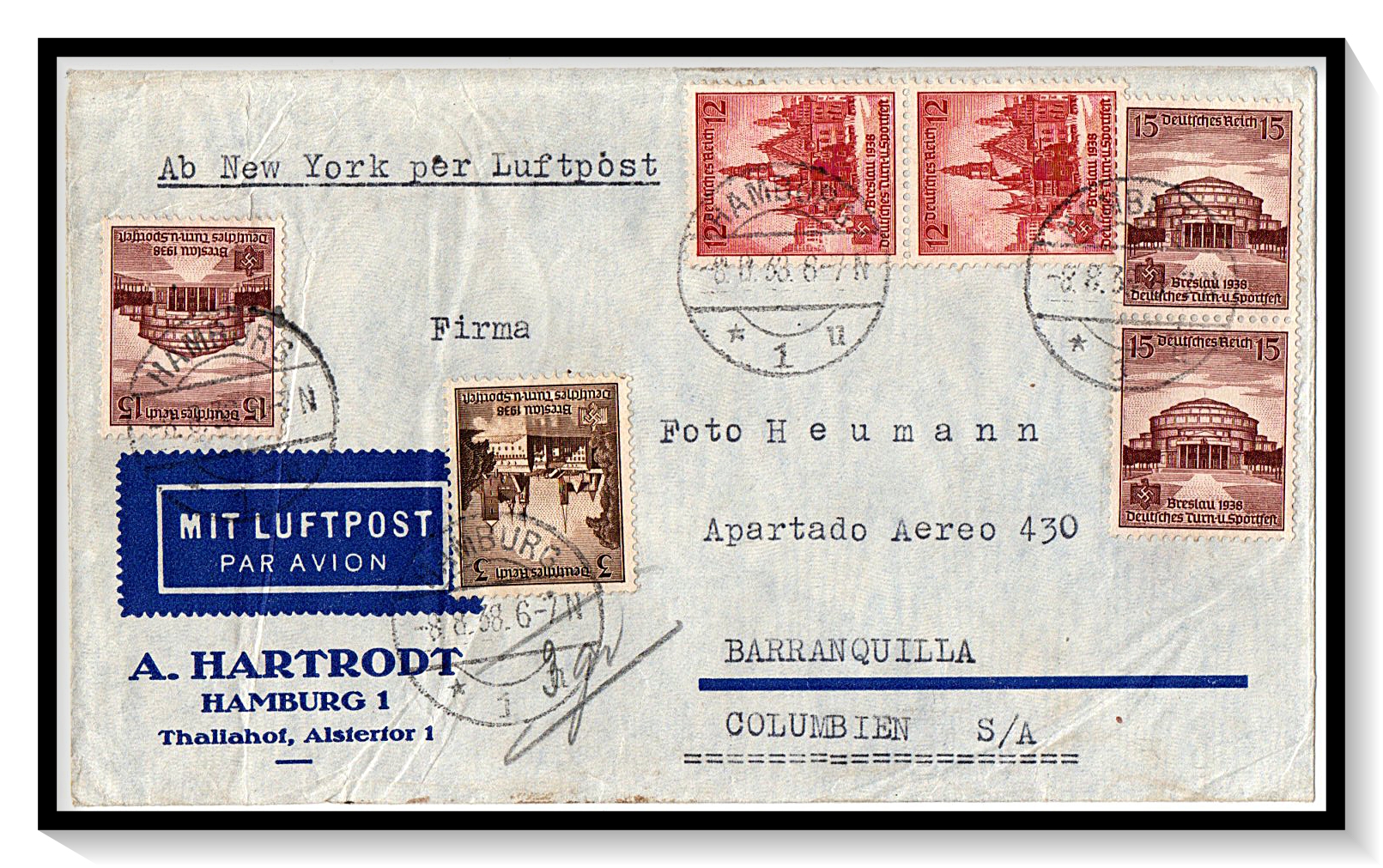
This envelope represents a significant postal document reflecting the commercial and technical communication networks established between Europe and South America during the early 20th century. The sender, A. Hartrodt, was a Hamburg-based logistics and transportation company. Founded in the late 19th century, the firm operated primarily in maritime transport and international freight organization. Given Hamburg's central role in global trade networks, such companies played a crucial role in facilitating the movement of goods and information between Europe and the American continents.
The recipient, identified as "Foto Heumann," was located in Barranquilla, Colombia. As a major Caribbean port city, Barranquilla emerged in the first half of the 20th century as one of the country's key commercial and distribution centers. The firm was most likely founded and operated by a photographer of German origin, Erwin Heumann. Its activities extended beyond conventional studio work, focusing particularly on urban landscapes and the visual documentation of the city. This suggests that the enterprise combined commercial photography with a documentary-oriented approach, contributing to the visual construction of urban identity.
The inscription "Ab New York per Luftpost" indicates that the item was routed via New York and transported by airmail. This detail highlights the multi-stage nature of transatlantic postal routes during the period. Mail originating in Europe was often directed first to North America before being forwarded to South America, reflecting the structure of early global airmail networks. Such routes were commonly used by businesses requiring faster communication.
The presence of the "Mit Luftpost / Par Avion" label clearly designates the item as airmail. German postage stamps and cancellations confirm that the envelope was processed through the official postal system under regulated tariffs. The arrival postmark from Barranquilla, dated August 1938, indicates successful delivery. Additional control markings suggest that the envelope underwent standard inspection procedures.
Within its broader economic context, this document demonstrates that the photographic and optical industries were not confined to local markets but were integrated into global trade networks. Photographic equipment and materials produced in Europe were exported to developing markets such as Latin America, creating multi-layered commercial connections between logistics firms, producers, and regional distributors.
Record Information
Title: Foto Heumann: German-Colombian Photography Studio in 1938
Category: Photographic Industry History / International Trade
Subcategory: Transatlantic Airmail / Studio Documentation
Country: Germany (Origin) → Colombia (Destination) (via USA) 🗺️ Show Route
City: Hamburg → Barranquilla (routed through New York)
Date of use: 1938 (arrival in Barranquilla: August 1938)
Company (Sender): A. Hartrodt, Hamburg - logistics and transportation company, founded late 19th century, specializing in maritime transport and international freight.
Company (Recipient): Foto Heumann, Barranquilla, Colombia. Studio founded by Erwin Heumann (German origin). Specialized in commercial photography and urban landscape documentation.
Object Type: International airmail cover ("Mit Luftpost / Par Avion")
Postal Route ✈️🚢: Hamburg, Germany → New York, USA → Barranquilla, Colombia (1938 Transatlantic Route)
Estimated Travel Time: Approximately 7-10 days (Hamburg → New York: 3-5 days by air/sea, New York → Barranquilla: 2-4 days by air)
Postal Features: "Mit Luftpost / Par Avion" label, "Ab New York per Luftpost" routing instruction, German stamps and cancellations, Barranquilla arrival postmark (August 1938), control/inspection markings
Language: German, Spanish
Material: Paper envelope
Dimensions: Standard envelope format
Collection Theme: German-Latin American photographic trade, Erwin Heumann studio history, Barranquilla commercial photography, transatlantic airmail development, 1930s logistics networks, urban visual documentation
Archival Significance: This 1938 airmail cover documents the connection between German logistics firm A. Hartrodt and the Barranquilla-based studio Foto Heumann, founded by German photographer Erwin Heumann. The routing "Ab New York per Luftpost" and arrival postmark provide precise evidence of early airmail infrastructure. This item is a primary source for understanding how European photographic expertise and commerce reached South American markets in the 1930s.
Research Note:
This article is based on historical research and independent analysis of the material in the author's collection. The text has been prepared as an original interpretative study and does not reproduce copyrighted material.
This item is documented as part of the Photography in Postal History research project.
For research context, see the Research Methodology.
For academic reference, please refer to How to Cite This Archive.
Tuesday, 30 July 2024

Kamera-Werkstätten VEB: Origins of Praktica & Praktina Cameras

Date of use : c. 1950s-1960s, Iran

Kamera-Werkstätten VEB: Origins of Praktica & Praktina Cameras

This document is an airmail envelope reflecting international commercial correspondence between Iran and Germany. The inscription "The Portiran Trading Co. Ltd." identifies the sender as a company engaged in import and export activities. The Tehran address indicates that the firm operated within an important regional trade network.
Although detailed founding information about the company is limited, the designation "Import–Export" suggests that it functioned within international commercial systems, particularly in the circulation of industrial and technical goods.
The recipient, "Kamera-Werkstätte VEB," was a photographic and camera manufacturing enterprise located in Dresden-Niedersedlitz. The origins of this company date back to 1919, when it was founded by Paul Guthe and Benno Thorsch. In later years, significant structural changes occurred as Guthe relocated to Switzerland and Thorsch emigrated to the United States. Following these developments, ownership of the company changed, and it is known that the business was transferred to Charles A. Noble. After 1945, the company was nationalized and reorganized under state ownership, adopting the designation "VEB" (Volkseigener Betrieb).
Kamera-Werkstätte played an important role in the development of photographic technology during the mid-20th century and became widely recognized for the production of cameras under the Praktica brand. This production highlights the company's significance not only at a regional level but also within international industrial contexts. The company also produced Praktiflex and later Praktina models.
The presence of the "Par Avion" label indicates that the item was sent via airmail, reflecting the increasing importance of speed in international commercial communication. Iranian stamps and postal cancellations confirm that the document was processed through the official postal system.
Within its broader economic context, the document demonstrates ongoing trade relations between the Middle East and Europe in the field of photographic and optical industries. The production of cameras and related technologies relied on international connections and supply chains.
Record Information
Title: Kamera-Werkstätten VEB: Origins of Praktica & Praktina Cameras
Category: Photographic Industry History / International Trade
Subcategory: Camera Manufacturing / Cold War Commerce
Country: Iran (Origin) → East Germany (GDR) (Destination) 🗺️ Show Route
City: Tehran → Dresden-Niedersedlitz
Date of use: Mid-20th century (c. 1950s-1960s, inferred from company history)
Company (Sender): The Portiran Trading Co. Ltd., Tehran, Iran - Import-Export firm, likely involved in technical and industrial goods.
Company (Recipient): Kamera-Werkstätten VEB, Dresden-Niedersedlitz. Founded 1919 by Paul Guthe and Benno Thorsch; later transferred to Charles A. Noble; nationalized post-1945 as VEB. Renowned manufacturer of Praktica, Praktiflex, and Praktina cameras.
Object Type: International airmail cover ("Par Avion")
Postal Route ✈️: Tehran, Iran → Dresden, East Germany (1950s-60s Airmail Route)
Estimated Travel Time: Approximately 2-4 days (airmail via Middle East and Central European routes)
Postal Features: "Par Avion" label, Iranian stamps, Tehran postal cancellation
Language: English, Persian, German
Material: Paper envelope
Dimensions: Standard envelope format
Collection Theme: Kamera-Werkstätten history, Praktica camera legacy, Iran-GDR trade, Cold War-era commercial networks, East German camera exports, Middle Eastern photographic market
Archival Significance: This cover documents trade between Iran and the nationalized East German camera manufacturer Kamera-Werkstätten VEB, producer of the renowned Praktica line. The Portiran Trading Co.'s involvement illustrates the international demand for East German optical products. The "Par Avion" routing reflects the importance of airmail in Cold War commerce. This item is a primary source for understanding the global reach of East German camera exports and the integration of Middle Eastern markets into photographic supply chains.
Research Note:
This article is based on historical research and independent analysis of the material in the author's collection. The text has been prepared as an original interpretative study and does not reproduce copyrighted material.
This item is documented as part of the Photography in Postal History research project.
For research context, see the Research Methodology.
For academic reference, please refer to How to Cite This Archive.

Monday, 29 July 2024

Leopold Stump Pharmacy: Photography & Trade in Frankfurt

Date of use : 1948 Germany

Leopold Stump Pharmacy: Photography & Trade in Frankfurt

This document is a commercial envelope representing official correspondence from a business operating in Frankfurt am Main, Germany. The inscription "Leopold Stump – Löwen-Drogerie Photo-Handlung" indicates that the company was engaged in both chemical goods and photographic materials. The address on Leipziger Straße situates the firm within an important commercial district of Frankfurt. The term "Drogerie" in the company name indicates that the business was not limited to photographic materials but was also involved in the trade of chemical products. Such enterprises were often rooted in pharmacy-related traditions, and due to the chemically based nature of photography, they naturally expanded into the photographic sector.
Although detailed founding information about the company remains limited, the combined use of "Drogerie" and "Photo-Handlung" suggests a business model that included the sale of photographic chemicals, films, papers, and related consumables. These hybrid enterprises became increasingly common during the early 20th century due to the chemical foundations of photographic production.
The recipient is identified as the "Industrie- und Handelskammer," or Chamber of Industry and Commerce. In a major commercial center such as Frankfurt, this institution played a key role in regulating and supporting business activities. The document therefore reflects communication between a commercial enterprise and an official economic body.
Postal markings and the stamp indicate that the envelope was processed within the German postal system. Its simple layout reflects standard practices in commercial and institutional correspondence of the period.
In conclusion, this document illustrates the relationship between a business engaged in photographic and chemical trade and institutional economic structures, offering insight into the broader integration of the photographic industry within commercial systems.
Record Information
Title: Leopold Stump Pharmacy: Photography & Trade in Frankfurt
Category: Photographic Industry History / Commercial Correspondence
Subcategory: Business-Institution Relations / Hybrid Retail
Country: Germany
City: Frankfurt am Main (Leipziger Straße address)
Date of use: 1948
Company (Sender): Leopold Stump, Löwen-Drogerie Photo-Handlung, Frankfurt. A hybrid business combining a pharmacy/drugstore ("Drogerie") with a photographic materials shop ("Photo-Handlung"), selling chemicals, films, papers, and related consumables.
Recipient: Industrie- und Handelskammer (Chamber of Industry and Commerce), Frankfurt. Official economic regulatory and support body.
Object Type: Domestic commercial envelope (business correspondence)
Postal Features: German postal stamp, standard cancellation, simple layout typical of commercial/institutional correspondence
Language: German
Material: Paper envelope
Dimensions: Standard envelope format
Collection Theme: Hybrid photographic-chemical retail, Frankfurt commercial history, post-war business administration, pharmacy-photography connection, Chamber of Industry and Commerce correspondence.
Archival Significance: This 1948 envelope from Leopold Stump's Löwen-Drogerie Photo-Handlung to the Frankfurt Chamber of Industry and Commerce illustrates the integration of photography into existing retail structures. The hybrid "Drogerie" and "Photo-Handlung" model reflects the chemical foundations of photography, which allowed pharmacies to expand into photographic supply. This document is a primary source for understanding how photographic materials reached consumers through diversified local businesses and how those businesses interacted with official economic institutions in post-war Germany.
Research Note:
This article is based on historical research and independent analysis of the material in the author's collection. The text has been prepared as an original interpretative study and does not reproduce copyrighted material.
This item is documented as part of the Photography in Postal History research project.
For research context, see the Research Methodology.
For academic reference, please refer to How to Cite This Archive.