Thursday, 11 July 2024

Fotokunst by Herman Schlegel: Photography Art & Materials in Berlin

Date of use : 1948 Germany

Fotokunst by Hermann Schlegel: Photography Art & Materials in Berlin

This document represents an important postal cover illustrating commercial relations between photographic businesses and manufacturing firms in post-war Germany, particularly within the Soviet occupation zone. The inscription "Fotokunst Hermann Schlegel" identifies the sender as a photographic studio or commercial photography business operating in Saalfeld-Saale. The term "Fotokunst" suggests an emphasis not only on technical production but also on artistic photographic practice. The sender's address is Saalstraße 32.
The sender's address at Saalstraße 32 indicates a locally based enterprise serving a regional clientele. Although detailed biographical information about Hermann Schlegel is limited, such businesses were typically operated as small, independently managed studios.
The recipient, "Luis Langebartels G.m.b.H., Fabrik Photogr. Papiere," refers to a photographic paper manufacturing company located in Berlin-Charlottenburg. Firms of this type specialized in the production of light-sensitive photographic papers, which were essential components of the photographic process. The designation "Fabrik" confirms its industrial nature. The correspondence can therefore be interpreted as part of a supply or ordering relationship between a studio and a manufacturer.
The stamp bearing the inscription "Sowjetische Besatzungszone" indicates that the item circulated within the postal system established in the Soviet occupation zone after 1945. The Saalfeld cancellation dated 1948 places the document within the immediate post-war period, during which Germany's postal infrastructure was undergoing reorganization under occupation authorities.
In terms of postal characteristics, the envelope combines printed commercial elements with handwritten markings, reflecting a standard format for business correspondence. Although it does not carry a registered mail marking, its direct link between a photographic studio and a manufacturing firm suggests commercial relevance.
Within its broader economic context, the document provides insight into the reconstruction of the photographic industry in post-war Germany. The supply of essential materials such as photographic paper was crucial for both professional and amateur photography. Such correspondence serves as micro-level evidence of economic recovery and the continuation of commercial networks.
From a collecting perspective, this cover intersects several thematic categories, including post-war German postal history, Soviet occupation zone philately, and the photographic industry. Its direct connection between producer and user enhances its archival value.
Record Information
Title: Fotokunst by Hermann Schlegel: Photography Art & Materials in Berlin
Category: Photographic Industry History / Post-War Reconstruction
Subcategory: Commercial Correspondence / Soviet Occupation Zone
Country: Soviet Occupation Zone (Germany) → Berlin (Western sector)
City: Saalfeld-Saale → Berlin-Charlottenburg
Date of use: 1948 (Saalfeld cancellation)
Company (Sender): Fotokunst Hermann Schlegel, Saalstraße 32, Saalfeld-Saale - Photographic studio and commercial photography business emphasizing artistic practice.
Company (Recipient): Luis Langebartels G.m.b.H., Fabrik Photogr. Papiere (Photographic Paper Factory), Berlin-Charlottenburg.
Object Type: Commercial envelope (business correspondence)
Postal Features: Stamp with "Sowjetische Besatzungszone" inscription, Saalfeld postal cancellation (1948), standard business format
Language: German
Material: Paper envelope
Dimensions: Standard envelope format
Collection Theme: Post-war German photographic industry, Soviet occupation zone postal history, studio-manufacturer relations, reconstruction of commercial networks, photographic paper supply.
Archival Significance: This 1948 cover documents the commercial link between a photographic studio in the Soviet occupation zone and a Berlin-based manufacturer of photographic paper. It provides evidence of continued business relations across emerging Cold War divisions and illustrates the material supply chains essential for photographic practice during Germany's post-war reconstruction. The "Sowjetische Besatzungszone" stamp places it within a specific postal and political context, enhancing its value for understanding the period's economic geography.
Research Note:
This article is based on historical research and independent analysis of the material in the author's collection. The text has been prepared as an original interpretative study and does not reproduce copyrighted material.
This item is documented as part of the Photography in Postal History research project.
For research context, see the Research Methodology.
For academic reference, please refer to How to Cite This Archive.

Tuesday, 9 July 2024

A. Ganis & V. Ozols: Photo Shop and Amateur Lab in Wartime Riga

Date of use : 1943 Latvia

A. Ganis & V. Ozols: Photo Shop and Amateur Lab in Wartime Riga

This document represents a significant postal cover illustrating commercial and institutional connections between the Baltic region and Germany during the Second World War. The heading "Foto–Film Riga" and the accompanying business details clearly indicate that the sender was a photographic supply company operating in Riga. The address Kalku iela 16 suggests a location within a central commercial district.
The names A. Ganiņš and V. Ozols are likely associated with the management of the business. The bilingual presentation reflects the multilingual commercial structure of the region. The phrase "Foto-Geschäft und Amateur-Laboratorium" indicates that the company functioned both as a retail outlet and as a service provider offering laboratory facilities for amateur photographers.
The recipient, Otto Perutz in Munich, refers to a well-established photographic materials manufacturer. The company was founded in the 1880s by Otto Perutz and became particularly known for the production of photographic paper. Its activities focused on light-sensitive papers and related chemical processes, placing it among the important contributors to the European photographic industry. The correspondence can therefore be interpreted as part of a commercial exchange between a regional distributor and an industrial producer.
The marking "Einschreiben" indicates that the item was sent as registered mail, typically used for commercially valuable documents. The "Ostland – Deutsches Reich" stamps and Riga postal cancellations show that the item circulated within the administrative framework established by Nazi Germany in the Baltic region.
In its broader economic context, the document demonstrates that the circulation of photographic materials continued despite wartime conditions. Photographic paper, film, and chemicals remained essential for both commercial and technical uses, reflecting the resilience of the photographic industry.
From a collecting perspective, this cover intersects multiple thematic fields, including wartime postal history, the photographic industry, and international trade networks. Its direct connection to the Otto Perutz company further enhances its archival significance.
Record Information
Title: A. Ganis & V. Ozols: Photo Shop and Amateur Lab in Wartime Riga
Category: Photographic Industry History / Wartime Commerce
Subcategory: Regional Distribution / Registered Mail
Country: Ostland (Occupied Latvia) → Germany
City: Riga → Munich
Date of use: circa 1943
Company (Sender): Foto–Film Riga (A. Ganiņš & V. Ozols), Kalku iela 16, Riga. Described as "Foto-Geschäft und Amateur-Laboratorium" (Photo shop and amateur laboratory).
Company (Recipient): Otto Perutz, Munich - manufacturer of photographic paper and chemicals, founded 1880s.
Object Type: Registered commercial cover (Einschreiben)
Postal Features: "Einschreiben" marking, "Ostland – Deutsches Reich" stamps, Riga postal cancellations, wartime postal administration
Language: German, Latvian
Material: Paper envelope
Dimensions: Standard envelope format
Collection Theme: Otto Perutz company history, Baltic-German trade, WWII postal system, photographic supply chains, amateur laboratory services.
Archival Significance: This 1943 registered cover documents a commercial link between a Riga photo shop and the renowned German manufacturer Otto Perutz during WWII. It illustrates the continued operation of photographic supply chains under occupation, with the shop offering both retail and amateur laboratory services. The "Einschreiben" marking and "Ostland" stamps place it within the wartime postal framework, making it a key artifact for understanding the photographic industry's resilience and regional trade networks in occupied Europe.
Research Note:
This article is based on historical research and independent analysis of the material in the author's collection. The text has been prepared as an original interpretative study and does not reproduce copyrighted material.
This item is documented as part of the Photography in Postal History research project.
For research context, see the Research Methodology.
For academic reference, please refer to How to Cite This Archive.

Monday, 8 July 2024

Dr. E. Vogel’s Handbook Sent to Optical Factory in Alsace

Date of use : 1908 Germany

Dr. E. Vogel's Handbook Sent to Optical Factory in Alsace

"Dr. E. Vogel's Taschenbuch der Photographie" (Dr. E. Vogel's Handbook of Photography) is a historical book in the field of photography. This book is particularly noted for its significant contributions at the end of the 19th century and the beginning of the 20th century. Dr. Ernst Vogel was a German photographer and chemist who made important contributions to photography and chemistry. The book covers a wide range of topics related to photography, including: principles of photographic optics, chemical processes used in developing photographs, various photographic techniques and methods, practical tips for photographers, and innovations in photography equipment and materials.
"Taschenbuch der Photographie" underwent several editions reflecting the rapid developments in photography technology during Vogel's time. Each edition included the latest developments and techniques. The book served as a valuable resource by providing in-depth technical knowledge and practical guidance for both amateur and professional photographers. It was widely used as a reference during the early stages of photography, when the field was still developing and evolving. Published during a period when photography transitioned from a scientific curiosity to a widely practiced art form and commercial enterprise, the book holds historical significance for documenting the technology and practice of photography during its early evolution.
The letter was sent to Victor Avril Optische Glasfabrik. The factory was established by Victor Avril in Zabern (now known as Saverne, France). Zabern is located in the Alsace region, which has historically been an important center for the optical and glass industry. In general, the factory produced high-quality optical glass for microscopes, telescopes, cameras, and other optical devices. The products of the factory were used in scientific research, military applications, and various areas of everyday life. They made significant contributions especially in the fields of photography and astronomy.
Record Information
Title: Dr. E. Vogel's Handbook Sent to Optical Factory in Alsace
Category: Photographic Literature / Optical Industry History
Subcategory: Technical Publications / Commercial Correspondence
Country: Germany → Alsace-Lorraine (German Empire / France border region) 🗺️ Show Route
City: (German origin) → Zabern (Saverne), Alsace
Date: 1908 (10th-20th edition)
Author: Dr. Ernst Vogel (German photographer and chemist)
Publication: Dr. E. Vogel's Taschenbuch der Photographie
Recipient: Victor Avril Optische Glasfabrik, Zabern
Postal Route 📚🚂 (Estimated Route): Germany → Zabern (Saverne), Alsace (c.1908)
Estimated Travel Time: Approximately 2-4 days (train through Germany to Alsace)
Object Type: Postal cover / book shipment
Language: German
Material: Paper envelope
Dimensions: Standard early 20th century envelope format
Collection Theme: History of photographic literature, optical glass manufacturing, technical knowledge dissemination
Archival Significance: This 1908 shipment of Dr. Vogel's handbook documents the circulation of technical photographic knowledge. The handbook guided photographers through rapid technological developments. The shipment to Victor Avril's optical factory in Alsace illustrates the connection between photographic literature and the optical industry, highlighting how technical publications supported manufacturers producing lenses and optical equipment for photography.
Research Note:
This article is based on historical research and independent analysis of the material in the author's collection. The text has been prepared as an original interpretative study and does not reproduce copyrighted material.
This item is documented as part of the Photography in Postal History research project.
For research context, see the Research Methodology.
For academic reference, please refer to How to Cite This Archive.

Friday, 5 July 2024

Bulletin of the Lorraine Society of Photography (1889–)

Date of use : 1900 France

Bulletin of the Lorraine Society of Photography (1889–)

This document represents an important postal artifact illustrating the publishing and communication practices of photographic institutions in late nineteenth-century France. The printed title "Bulletin de la Société Lorraine de Photographie" clearly identifies the item as a journal mailing rather than an ordinary letter. This publication, issued by the Société Lorraine de Photographie, began in 1889, making this document a valuable example from the early phase of its distribution history. The front bears the instruction "NE PLIEZ PAS, S.V.P." (Do not fold, please).
The Société Lorraine de Photographie was a regional photographic society operating in the Lorraine area, particularly centered in Nancy. Throughout the nineteenth century, photographic societies across Europe played a crucial role in the dissemination of technical knowledge, the development of aesthetic standards, and the institutionalization of photography. The journal published by the society functioned as a structured medium through which photographic knowledge circulated among its members.
The presence of warnings such as "Ne pliez pas, s.v.p." and their equivalents in multiple languages indicates that the item contained printed material requiring careful handling. Such markings were commonly used in the postal distribution of periodicals to ensure their physical integrity. This reflects an organized and professional approach to the circulation of printed publications.
The addressee, "Monsieur O. Lemoine" at 17 Rue Saint-Dizier in Nancy, suggests that the journal was sent to an individual connected to the society. Given Nancy's status as a culturally active center at the time, it is plausible that the recipient was either a member of the society or a participant in the photographic field.
The date "Décembre 1899" on the reverse places this particular issue approximately ten years after the journal's founding. This period corresponds to a time when photography had become increasingly widespread and standardized, particularly among amateur practitioners. Journals played a central role in disseminating technical knowledge and shaping common practices.
From a philatelic perspective, the item bears a stamp of the French Republic along with a Nancy postal cancellation, confirming its transmission through the official postal system. The format used for printed matter suggests the existence of specific postal categories designed to facilitate the distribution of periodicals.
From a collecting standpoint, this document intersects multiple thematic areas, including photographic publishing, scientific societies, and postal history. Its association with the early years of a photographic journal significantly enhances its archival value. It also provides direct insight into how knowledge production and dissemination were organized within structured networks.
In conclusion, this document should be understood not merely as a postal item but as material evidence of the institutionalization of photographic knowledge in the late nineteenth century. The regular distribution of the Bulletin de la Société Lorraine de Photographie played a key role in transforming photography into an organized and collaborative discipline. As such, it represents a valuable archival resource for both photographic history and communication networks.
Record Information
Title: Bulletin of the Lorraine Society of Photography (1889–)
Category: Photographic History / Publishing History
Subcategory: Scientific Societies / Periodical Distribution
Country: France
City: Nancy (Société Lorraine de Photographie) → Nancy (local delivery)
Date of issue: Décembre 1899 (circulated circa 1900)
Organization: Société Lorraine de Photographie, founded 1889, Nancy
Publication: Bulletin de la Société Lorraine de Photographie (monthly or periodic journal)
Recipient: Monsieur O. Lemoine, 17 Rue Saint-Dizier, Nancy (society member or photographic practitioner)
Handling Instruction: "NE PLIEZ PAS, S.V.P." (Do not fold, please) – printed in multiple languages for postal care
Object Type: Periodical mailing envelope / Printed matter postal wrapper
Postal Features: French Republic stamp, Nancy postal cancellation, printed matter rate category
Language: French
Material: Paper envelope/wrapper
Dimensions: Standard periodical mailing format
Collection Theme: French regional photographic societies, 19th-century photographic literature, knowledge dissemination, Nancy cultural history, institutionalization of photography.
Archival Significance: This 1899/1900 mailing wrapper for the Bulletin de la Société Lorraine de Photographie documents the institutional circulation of photographic knowledge in fin-de-siècle France. It provides material evidence of how regional societies like the one in Nancy disseminated technical and aesthetic information to members. The "Ne pliez pas" instruction reflects the value placed on preserving printed matter. This item is a primary source for understanding the role of periodicals in shaping photographic practice and community.
Research Note:
This article is based on historical research and independent analysis of the material in the author's collection. The text has been prepared as an original interpretative study and does not reproduce copyrighted material.
This item is documented as part of the Photography in Postal History research project.
For research context, see the Research Methodology.
For academic reference, please refer to How to Cite This Archive.

Wednesday, 3 July 2024

Agfa Film Cover from Gold Coast Sent by Edy Kuhn

Date of use : 1938, Gold Coast (Ghana)

Agfa Film Cover from Gold Coast Sent by Edy Kuhn

This document represents a significant postal cover illustrating commercial and cultural networks between West Africa and Europe in the early twentieth century. The information on the envelope clearly indicates that it was sent from Kumasi, located in the British colony of the Gold Coast, to St. Gallen in Switzerland. This route reflects the movement of goods and communication between colonial economies and European commercial centers. The recipient address is Miss A. Reifler, 14 Vadianstrasse, St. Gallen, Switzerland.
The sender is identified as "Edy Kuhn, c/o U.T.C. Ltd., Kumasi," suggesting an individual operating within a corporate framework. U.T.C. Ltd. (United Trading Company) was one of the major commercial enterprises active in West Africa, playing a central role in regional import-export activities. The sender was therefore likely a commercial representative or employee engaged in trade-related operations.
On the reverse side, the presence of an "Agfa" advertising label establishes a direct connection to the photographic industry. Agfa was a major German company specializing in photographic film, chemicals, and paper, with a strong international presence during this period. The slogan "Film is known the world over" reflects a global marketing strategy emphasizing brand recognition and product distribution across multiple continents. The use of such labels on correspondence demonstrates that photographic materials were actively circulated not only within Europe but also across distant colonial markets.
The recipient, "Miss A. Reifler" in St. Gallen, points to an individual or business located in a city known for its commercial and industrial activity. While the exact nature of the recipient's profession is not explicitly stated, it is plausible that she was connected to photographic trade or usage, given the context of the material.
From a postal history perspective, the "Registered" marking indicates that the item was sent as registered mail, a service typically used for valuable or important documents. The departure markings from Kumasi and the arrival cancellation in St. Gallen dated 26 April 1938 demonstrate the traceability and controlled handling of the shipment within the international postal system. The Gold Coast stamps further reflect the colonial postal framework of the British Empire.
In its broader economic context, this document illustrates the distribution of industrial products from Europe into colonial markets and the reciprocal commercial exchanges that followed. Photographic materials, including film, played an essential role not only in professional practice but also in administrative and commercial documentation. This highlights the global expansion of photographic technology and its integration into economic systems.
From a collecting perspective, this cover belongs to multiple thematic categories, including colonial postal history and the global trade of photographic materials. The advertising label also contributes to the study of visual culture and brand history. As such, the document functions as more than a postal artifact; it is a layered archival object reflecting trade, technology, and communication networks.
Record Information
Title: Agfa Film Cover from Gold Coast Sent by Edy Kuhn
Category: Photographic Industry History / Colonial Trade
Subcategory: Advertising Ephemera / Registered Mail
Country: Gold Coast (British colony, now Ghana) (Origin) → Switzerland (Destination) 🗺️ Show Route
City: Kumasi → St. Gallen
Date of use: 1938 (arrival in St. Gallen: 26 April 1938)
Sender: Edy Kuhn, c/o U.T.C. Ltd. (United Trading Company), Kumasi - commercial representative or employee
Recipient: Miss A. Reifler, 14 Vadianstrasse, St. Gallen, Switzerland
Brand: Agfa (German photographic film, chemicals, and paper manufacturer)
Advertising Slogan: "Film is known the world over" (on reverse label)
Object Type: Registered commercial cover
Postal Route 🚢: Kumasi → St. Gallen
Estimated Travel Time: Approximately 2-3 weeks (by sea and rail via West African coastal routes and European rail network)
Postal Features: "REGISTERED" marking, Gold Coast stamps, Kumasi dispatch cancellation, St. Gallen arrival cancellation (26 April 1938)
Language: English
Material: Paper envelope
Dimensions: Standard envelope format
Collection Theme: Agfa global marketing, Gold Coast colonial postal history, U.T.C. Ltd. commercial network, Swiss-West African trade, photographic material distribution, 1930s advertising
Archival Significance: This 1938 registered cover documents the global reach of Agfa's photographic brand, with its advertising label traveling from West Africa to Switzerland. It illustrates how colonial commercial networks (via U.T.C. Ltd.) facilitated the distribution of photographic materials. The cover uniquely combines colonial postal history, brand marketing, and the material culture of photography, showing how products like Agfa film were promoted and circulated across continents.
Research Note:
This article is based on historical research and independent analysis of the material in the author's collection. The text has been prepared as an original interpretative study and does not reproduce copyrighted material.
This item is documented as part of the Photography in Postal History research project.
For research context, see the Research Methodology.
For academic reference, please refer to How to Cite This Archive.

Monday, 1 July 2024

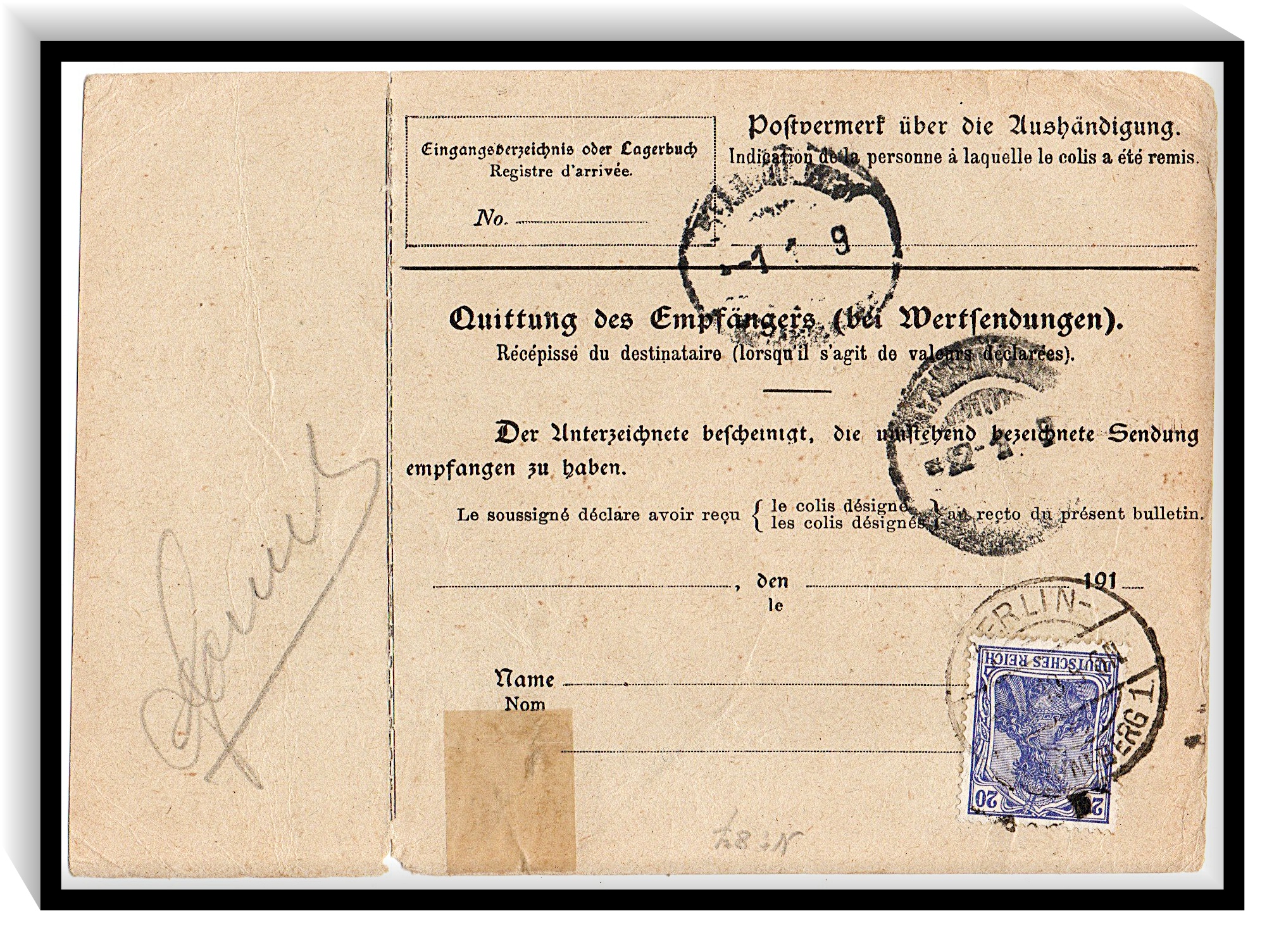
KARTOPHOT Package Card Sent from Berlin to Constantinople

Date of use : 1918, Germany

KARTOPHOT Package Card Sent from Berlin to Constantinople

This document represents an important postal and logistical form illustrating commercial connections between Europe and the Ottoman Empire in the early twentieth century. Its structured layout and multilingual content indicate that it is not a simple envelope but an official accompanying document used for international parcel shipments. The use of both German and French reflects the standardized communication practices of the international postal system of the period.
The sender, Kartophot G.m.b.H., was a Berlin-Schöneberg-based company operating in the field of photographic materials. Available evidence suggests that the firm specialized in the trade of photographic paper. This indicates that Kartophot functioned primarily as a distributor and supplier rather than a manufacturer. Berlin's role as a major center for photographic and printing technologies at the time facilitated the expansion of such firms into international markets.
The recipient is addressed through the Ottoman Imperial Post Office in Constantinople, with the name "Mrs. Dollinger & Dielmann" likely referring to a local commercial agent, distributor, or business dealing with photographic supplies. This reflects direct commercial links between European suppliers and local actors within the Ottoman market.
The marking "Via Oesterreich" indicates that the shipment was routed through Austria, one of the principal transit corridors connecting Central Europe to the Ottoman Empire. The development of railway infrastructure enabled faster and more reliable transportation along this route. The document therefore provides insight not only into postal procedures but also into the logistics of international trade.
From a philatelic perspective, the presence of German Empire stamps and Berlin postal cancellations confirms that the item was processed through the official postal system. The reverse side includes a delivery confirmation section, demonstrating that the shipment was subject to control and verification procedures typical of commercial consignments with declared value.
From a collecting perspective, this document holds significant value across multiple themes. It serves as a primary source for the distribution and trade of photographic materials, while also illustrating the interaction between European and Ottoman postal systems. The circulation of photographic paper as a key material highlights the global organization of photographic practice.
Record Information
Title: KARTOPHOT Package Card Sent from Berlin to Constantinople
Category: Photographic Industry History / Postal Logistics
Subcategory: International Trade / Parcel Post
Country: German Empire (Origin) → Ottoman Empire (Destination) 🗺️ Show Route
City: Berlin-Schöneberg → Constantinople (Istanbul) (via Austria)
Date of use: circa 1918
Company (Sender): Kartophot G.m.b.H., Berlin-Schöneberg - distributor of photographic paper and materials
Recipient: Mrs. Dollinger & Dielmann, Ottoman Imperial Post Office, Constantinople (commercial agent or distributor)
Product: Photographic paper (primary trade item)
Object Type: International parcel post accompanying document / package card
Postal Route 🚂: Berlin, Germany → Constantinople, Ottoman Empire (via Austria / "Via Oesterreich")
Estimated Travel Time: Approximately 5-7 days (by rail via Vienna, Budapest, Belgrade, Sofia)
Postal Features: German Empire stamps, Berlin postal cancellations, "Via Oesterreich" routing mark, multilingual form (German/French), delivery confirmation section on reverse
Language: German, French
Material: Paper parcel card
Dimensions: Standard parcel form format
Collection Theme: German-Ottoman trade, Kartophot company history, photographic paper distribution, WWI-era logistics, Austro-German transit routes, international postal cooperation
Archival Significance: This 1918 package card documents the export of photographic paper from Berlin to Constantinople, illustrating German-Ottoman commercial ties during WWI. Kartophot's role as a distributor reflects Berlin's position in the photographic supply chain. The "Via Oesterreich" routing and bilingual form highlight the logistics and standardized procedures of international parcel post. It is a primary source for understanding the material trade supporting photographic practice in the Ottoman Empire.
Research Note:
This article is based on historical research and independent analysis of the material in the author's collection. The text has been prepared as an original interpretative study and does not reproduce copyrighted material.
This item is documented as part of the Photography in Postal History research project.
For research context, see the Research Methodology.
For academic reference, please refer to How to Cite This Archive.